 Djinious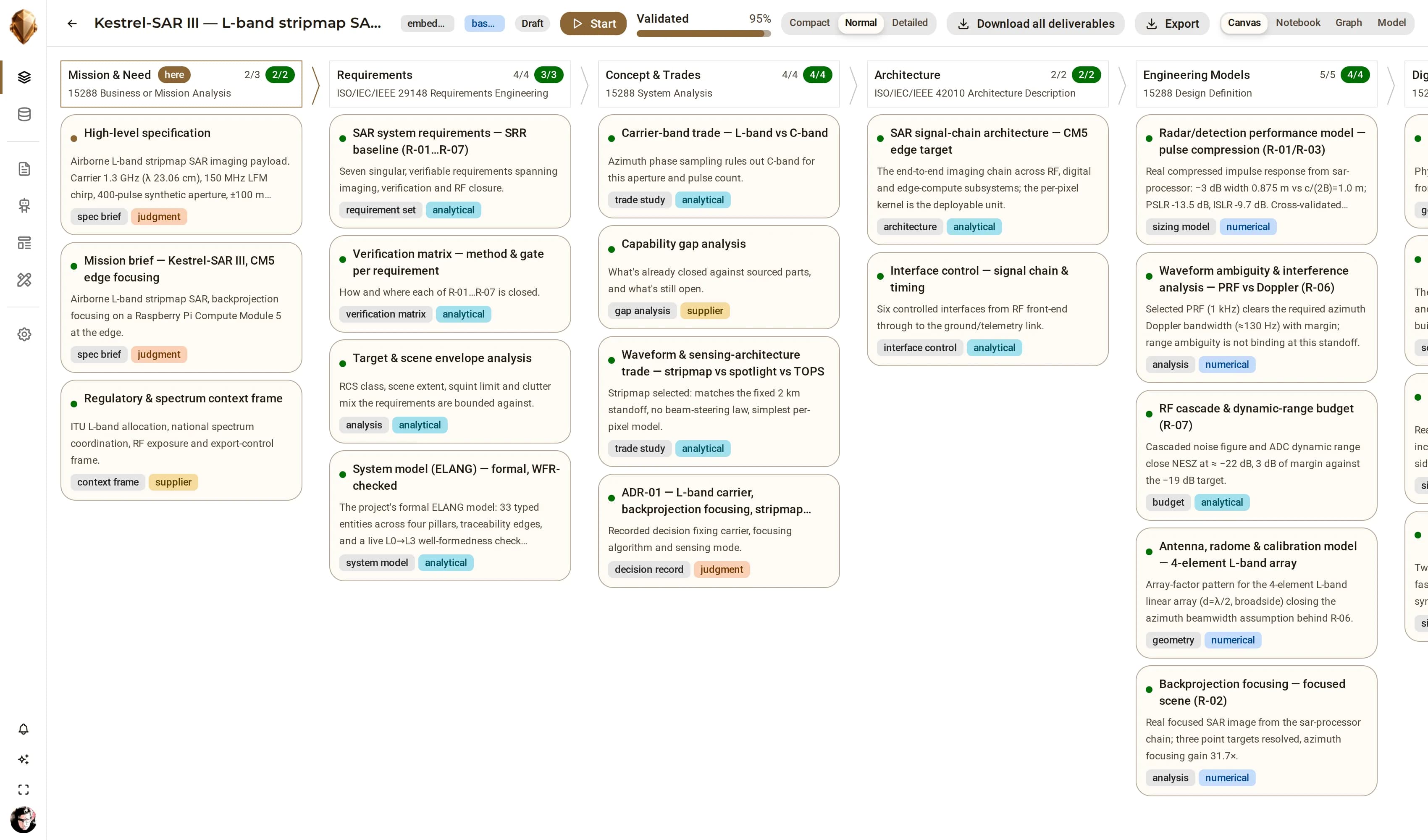
Memory-safe by construction
No buffer overruns, no use-after-free, no undefined behaviour — the classes of bug that safety standards spend their pages trying to exclude from generated C are absent from Rust by the language's own guarantees.
The platform
Each application does one part of the work — and hands its evidence to the next. Use them together, or one at a time.
Platform overviewSee how the loop runs DjiniousEngineeringOrchestration
 DjiniousLabModelling & simulation
 DjiniousWorkshopSystem integration
 DjiniousSafeCertifiable code
 DjiniousWorld3D replicas
 DjiniousMapAgent GIS
 DjiniousCCOperations & SCADA
 DjiniousDataKnowledge base
 DjiniousWorkflowAgent automation
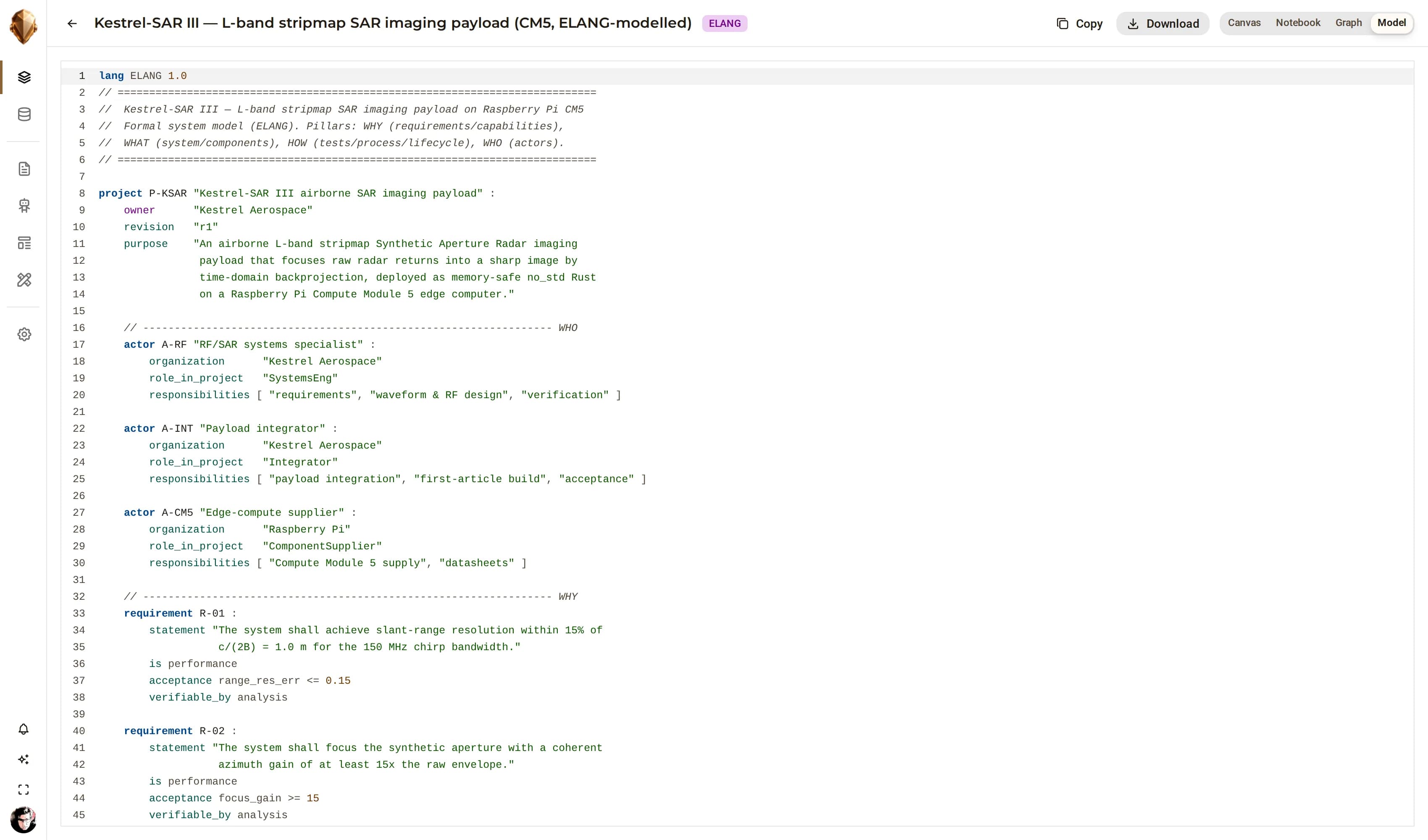
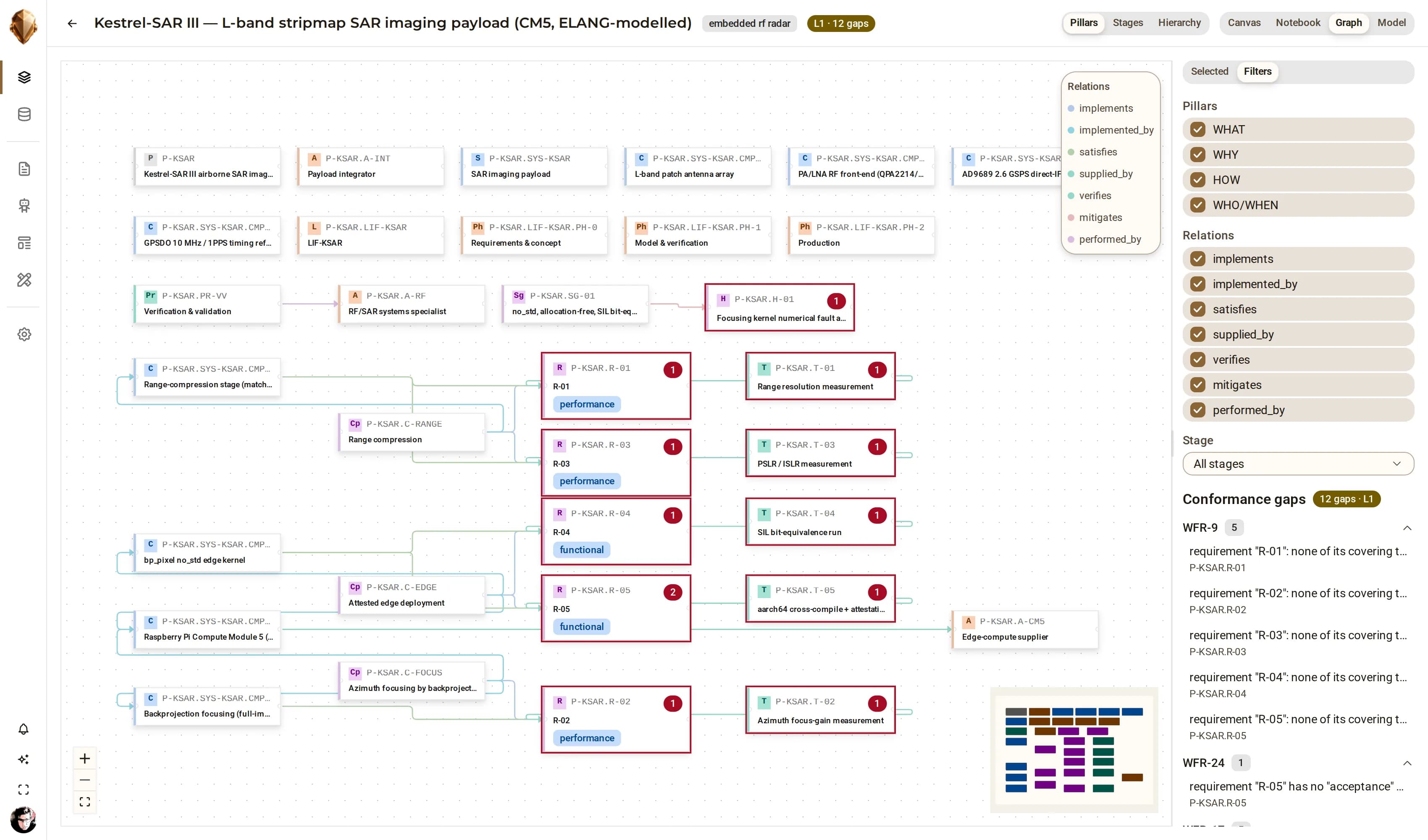
Model-based design to deployable code, the Rust-first way — an autopilot designed as block diagrams, code-generated to #![no_std] Rust, proven equivalent to the model, cross-compiled to a Cortex-M target, and attested for provenance.
 DjiniousLab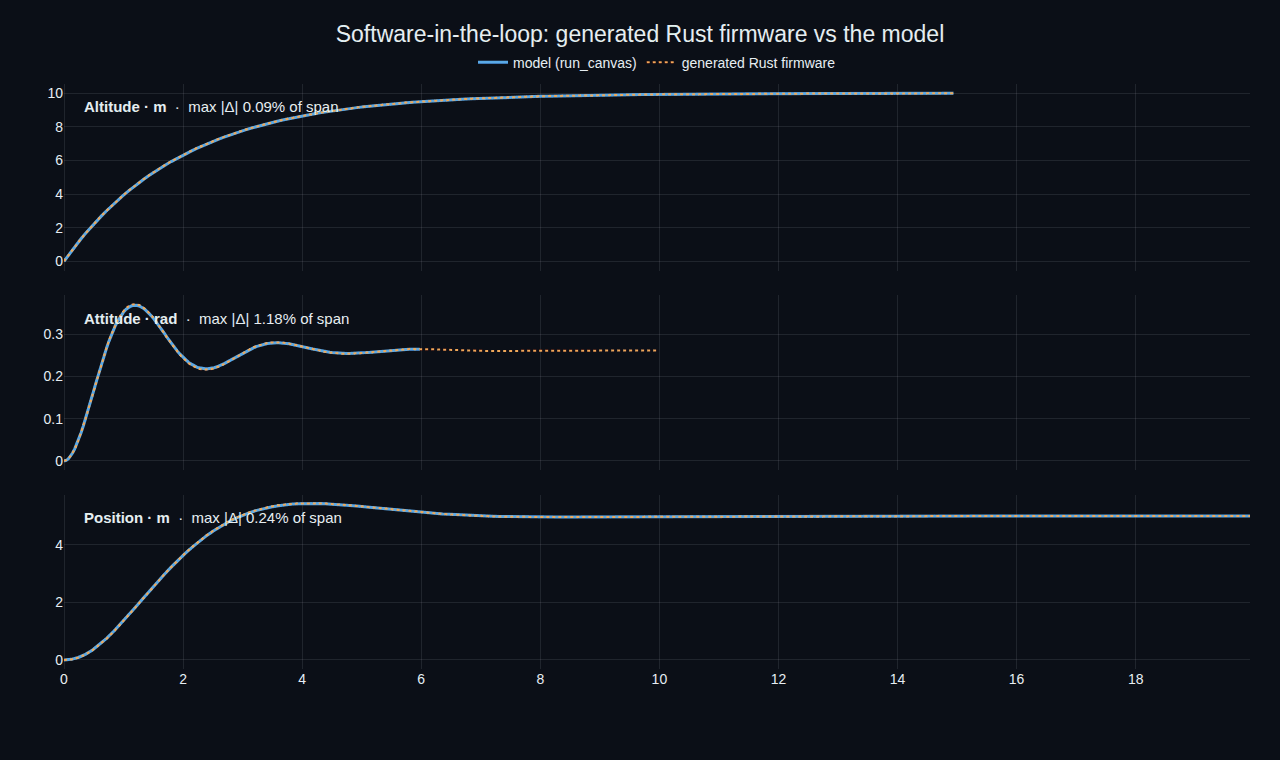
Simulating a system is half the job; shipping it is the other half. DjiniousLab code-generates a controller you designed as a block diagram into a self-contained, memory-safe Rust crate — proven equivalent to the model, cross-compiled to a microcontroller, and cryptographically attested. This is what Simulink's Embedded Coder does, except the generated artifact is Rust, not C — the difference that matters when the code is going somewhere safety-critical.
A control loop authored as a .djl block diagram lowers to a flat intermediate representation, and `djinious codegen` turns it into a Cargo crate: a State struct, an initial-condition constructor, and a `pub fn step(state, inputs, t, dt) -> Outputs` that advances the controller one tick. Add `--no-std` and it emits embeddable firmware with libm for math instead of the standard library. The same three Djinborn T4 autopilot loops — altitude, attitude, position — that the quadcopter program flies in simulation generate straight to Rust.
DjiniousLab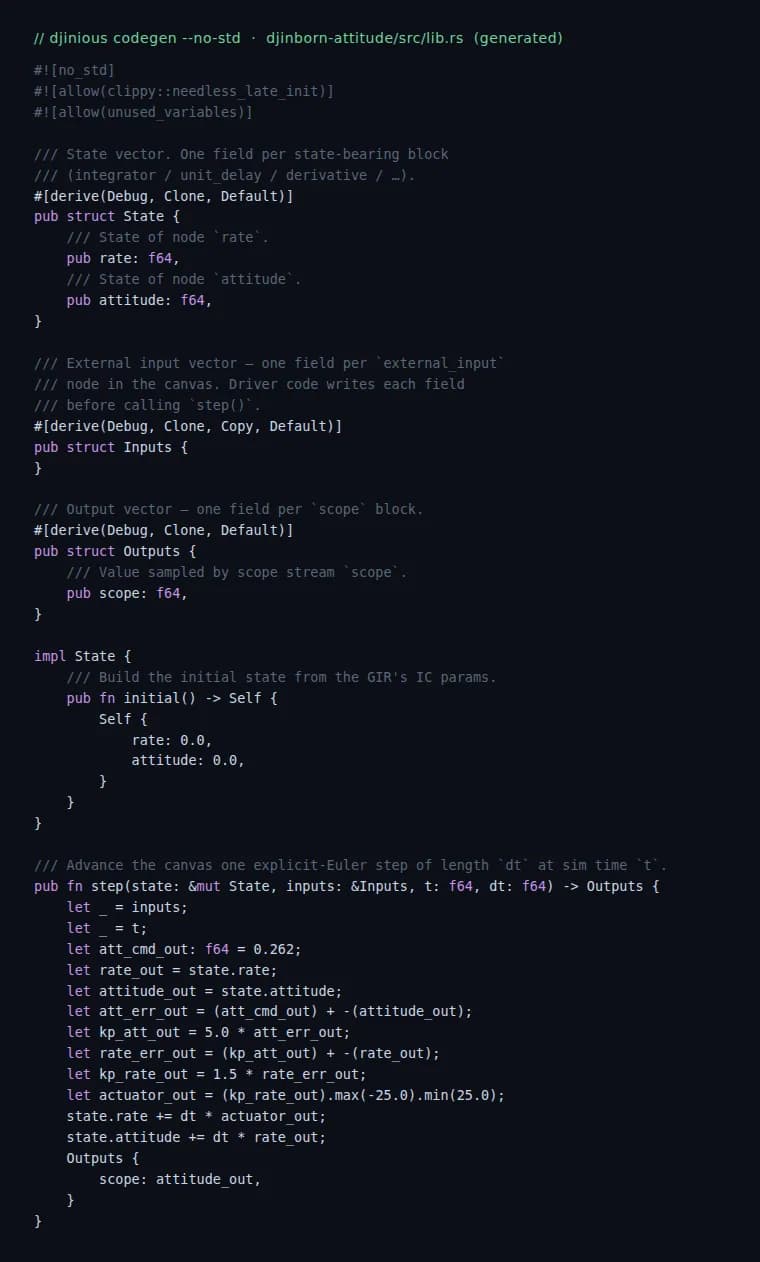
A controller is a feedback loop — the integrator output loops back into the error. The codegen used to emit blocks in declaration order, so a fed-back integrator's output could be referenced before it was bound: Rust that doesn't compile. The fix emits output bindings in topological order, treating integrator and delay outputs as dependency-free sources (their output reads stored state), which breaks the cycle; state updates are deferred to the end of the step. A feedback loop with no state element to break it is a genuine algebraic loop and now errors honestly instead of generating broken code. The full codegen suite — 765 unit tests plus 523 compile-and-run round trips — stays green.
DjiniousLabNo buffer overruns, no use-after-free, no undefined behaviour — the classes of bug that safety standards spend their pages trying to exclude from generated C are absent from Rust by the language's own guarantees.
The crates are `#![no_std]` with libm for transcendental math — no allocator, no operating system. They cross-compile to a bare-metal Cortex-M4F (STM32F4) target as verified here, ready for a board HAL and a timer ISR.
`djinious attest` binds the model to the firmware's SHA-256 in an in-toto Statement; `djinious sign` cosign-signs it. The supply-chain link from 'this model' to 'this binary' that certification asks for.
A software-in-the-loop harness runs the model and the firmware side by side and differences them — the generated code is gated on matching the reference, not assumed to.
The whole pipeline is real artifacts — lower, codegen, compile, run, diff, cross-compile, attest — not a slideware demo.
The generated code is fixed-step forward-Euler — the embedded norm — over the catalog signal-block palette (constant, sum, gain, integrator, saturation, scope and friends), which is exactly what a controller is built from. Custom nonlinear DJL components don't code-generate yet; they run in the Julia worker. Flashing onto a specific board needs a HAL crate and a `cortex-m-rt` entry point, and `sign` / `verify` need a local cosign — board integration and CI signing are beyond this program. What it delivers is the spine of model-based design done in Rust: design, simulate, generate, prove equivalent, and trace — end to end, on one tool.
Keep exploring
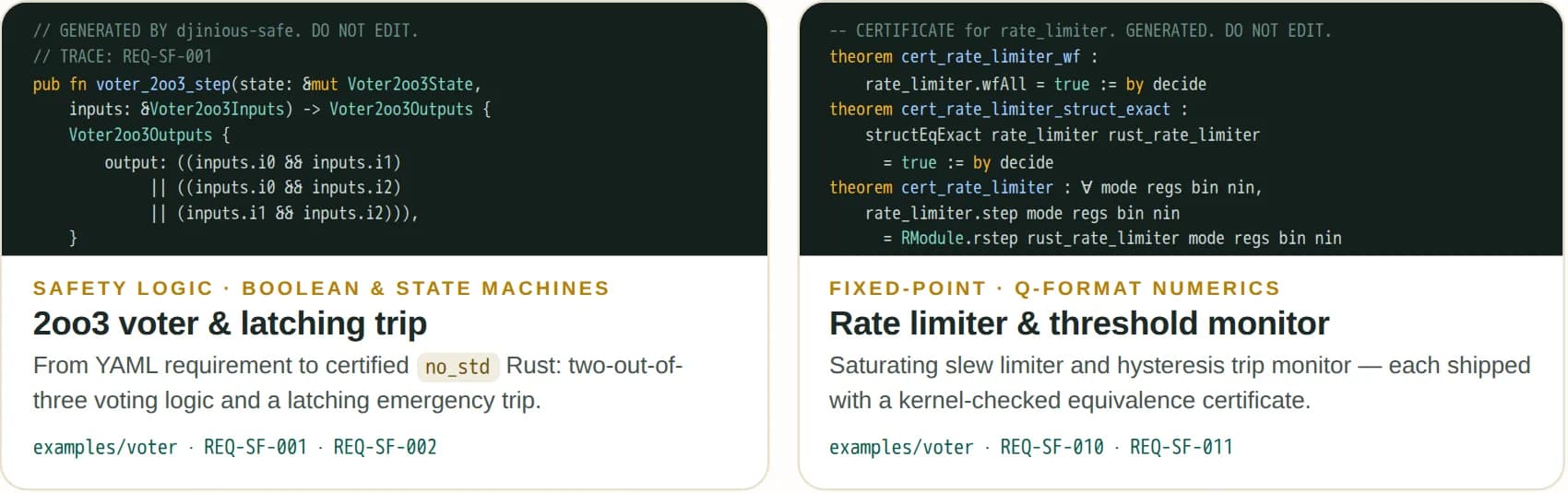 Safety-critical embedded controlNine safety functions, from YAML requirement to certified embedded RustThe voter reference project takes nine safety functions — voting, latching, slew limiting, trip monitoring, interlocks and a flow gauge with a floating-point boundary — through all thirteen gates, and replays every one on an emulated Cortex-M4F.
 DjiniousSafe
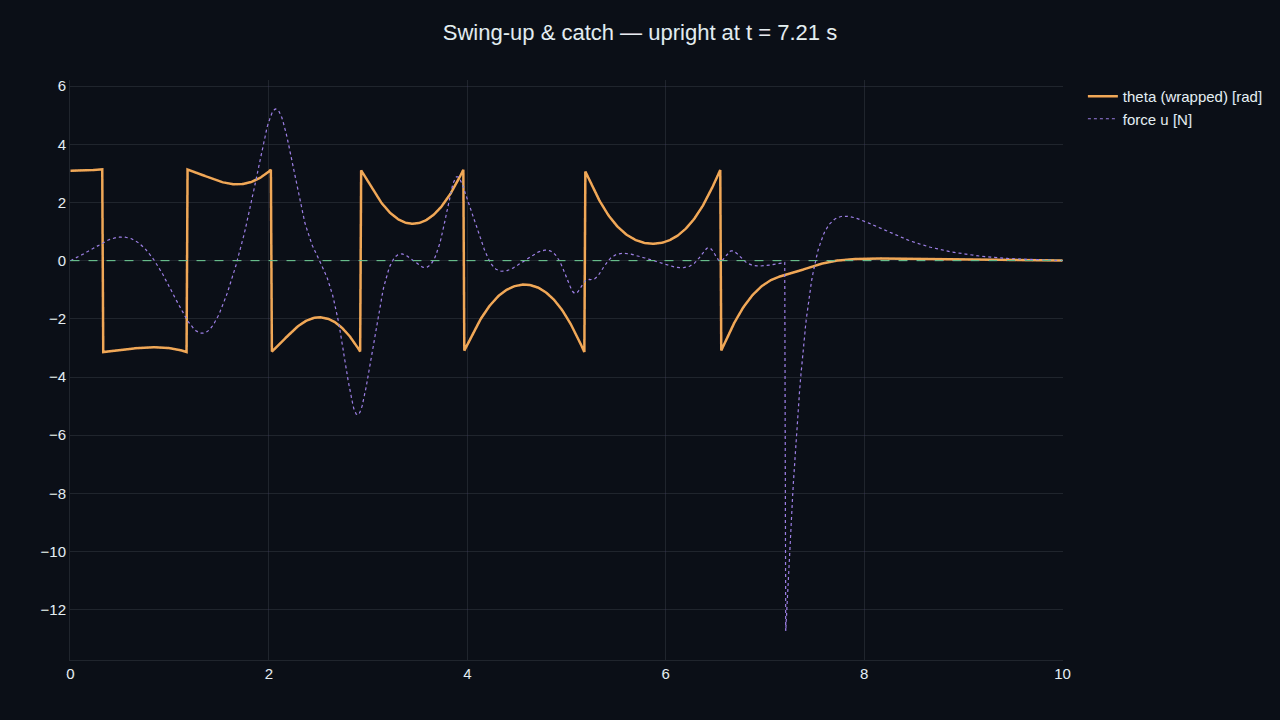 Control & reinforcement learningCart-pole control & RLThe canonical underactuated-control benchmark, taken end to end — nonlinear dynamics, an LQR that stabilises the inverted pole, energy swing-up, a model-free reinforcement-learning policy, and a Monte-Carlo robustness gate.DjiniousLab
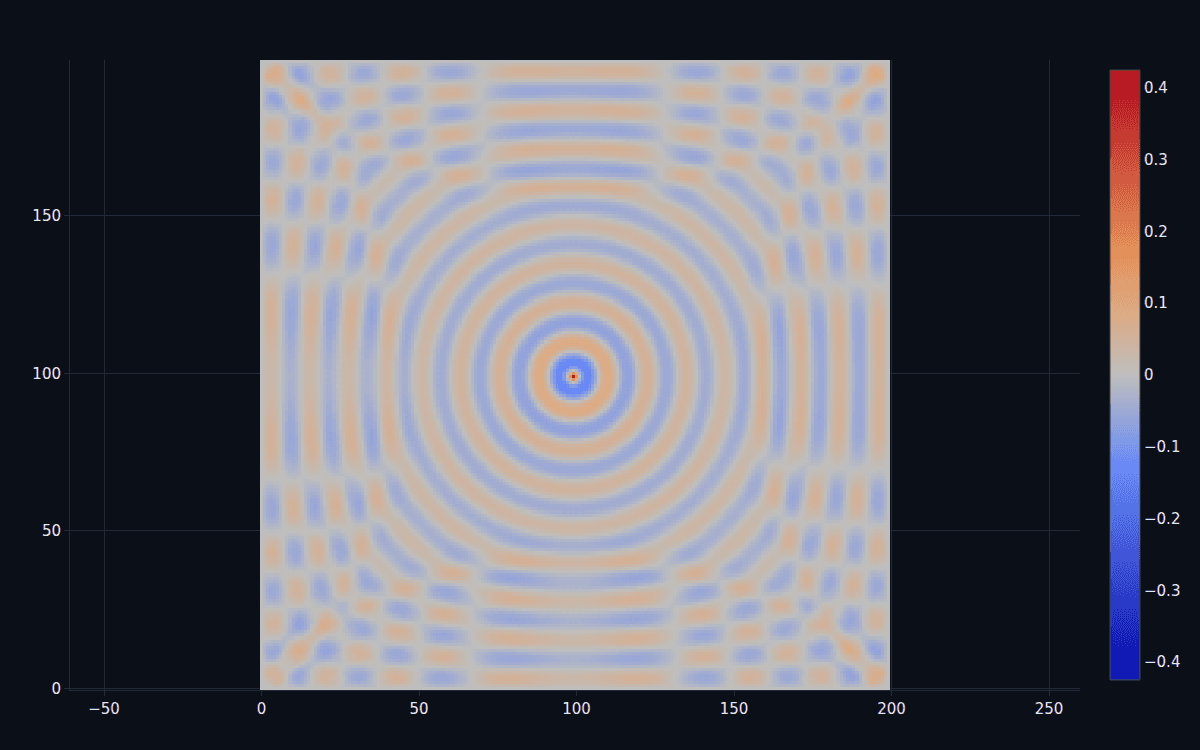 ElectromagneticsElectromagnetics (FDTD)Solving Maxwell's equations on a grid — the electric and magnetic fields leapfrogging through space and time. A self-contained FDTD solver reproduces the canonical wave phenomena: radiation, refraction, diffraction, scattering and cavity resonance. The field-solver sibling to CFD, in electromagnetics.DjiniousLab