 Djinious



State estimation
Recovering hidden state from noisy sensors with the Kalman family — linear KF, EKF and UKF, then GPS+IMU sensor fusion that holds a track straight through a GPS dropout, an EKF battery State-of-Charge estimator, and the consistency and outlier-rejection machinery that says when a filter can be trusted.
 DjiniousLab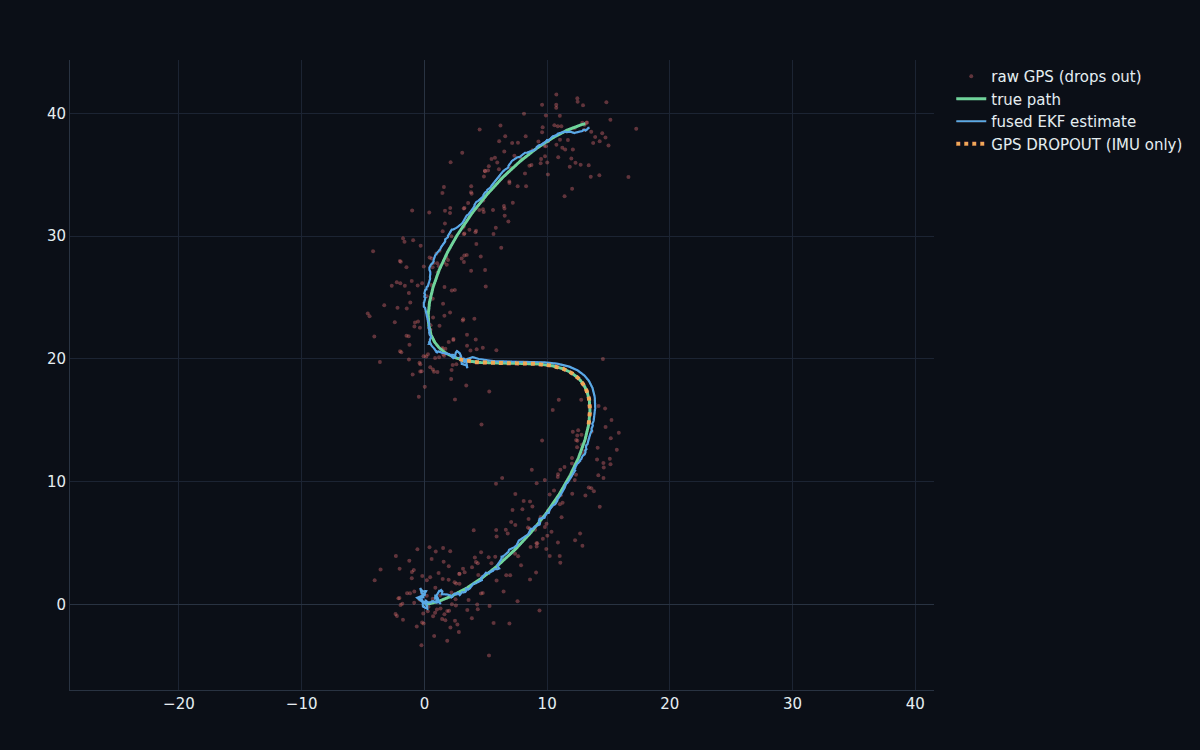
- fused error vs raw GPS through a dropout
- 0.28×fused error vs raw GPS through a dropout
- Kalman RMSE vs raw measurement
- 0.22×Kalman RMSE vs raw measurement
- RMSE cut from outlier gating
- 84%RMSE cut from outlier gating
- EKF convergence from a bad guess
- 1.10 sEKF convergence from a bad guess
- design notebooks
- 10design notebooks
- requirements PASS
- 5 / 5requirements PASS
Every other model simulates a plant. This one reads the sensors.
Most engineering models push a system forward in time. Real systems also have to run the other direction: take noisy, intermittent sensor readings and recover the true state behind them — position from jittering GPS, charge from a wandering battery voltage, an angle from a shaking gyro. That's state estimation, and the Kalman filter family is how it's done. This program builds it from the linear filter up through sensor fusion, and — just as important — shows the consistency, observability and outlier checks that tell you when to believe the answer.
Trust the model and the measurement in the right proportion.
The Kalman filter runs a predict/update recursion: a model predicts where the state should go, a measurement corrects it, and the filter weighs the two by their uncertainties — leaning on the model when the sensor is noisy, on the sensor when the model drifts. On a constant-velocity tracking problem it cuts position error to 0.22× the raw measurement and recovers an unmeasured velocity it never sees directly, while its ±1σ confidence band visibly shrinks as it locks on.
DjiniousLab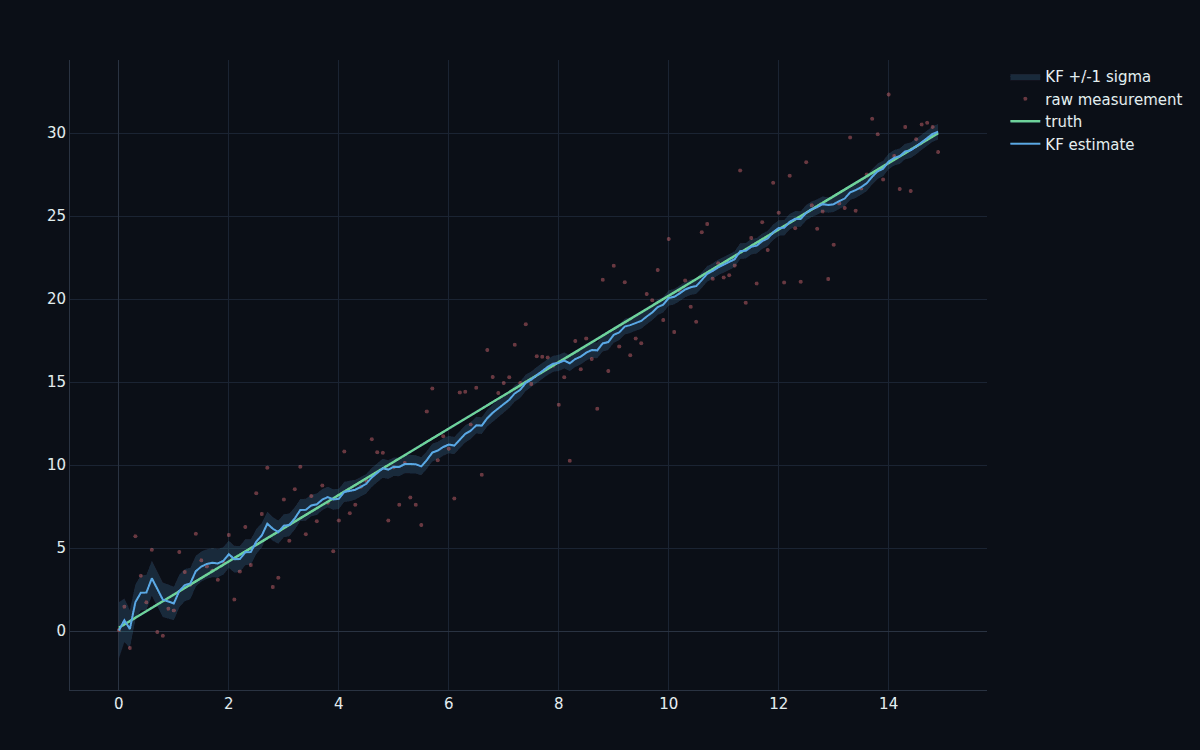
When the system curves, linearize — by Jacobian or by sigma points.
Real systems aren't linear. The Extended Kalman Filter linearizes the dynamics with an analytic Jacobian each step; the Unscented Kalman Filter skips the calculus entirely and propagates a set of sigma points through the true nonlinear model. On a pendulum the EKF locks on from a deliberately bad initial guess in 1.1 seconds, and the UKF matches or beats it under a hard 2.8-radian swing — no Jacobian required.
DjiniousLab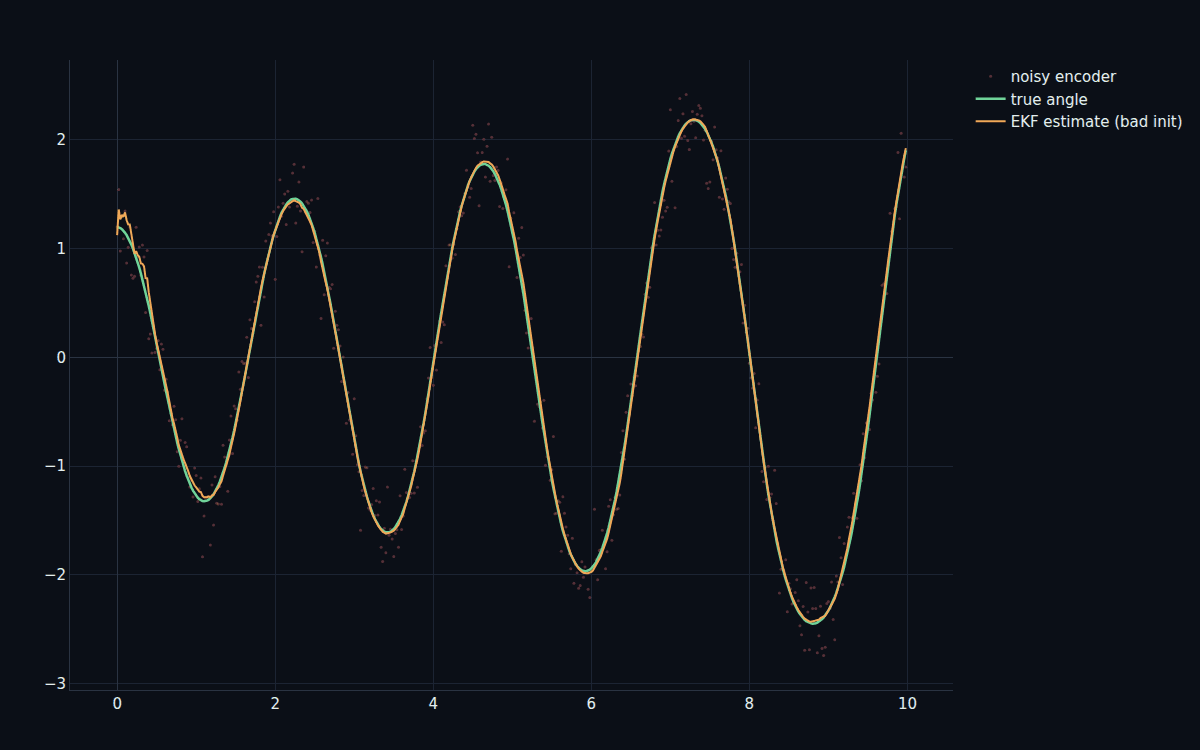 DjiniousLab
Estimate what you can't measure — a battery's charge.
You can't put a fuel gauge inside a battery; State-of-Charge has to be estimated from terminal voltage and current. An EKF on an equivalent-circuit battery model corrects a deliberately wrong initial SoC down to a 0.0002 final error, where naive coulomb-counting keeps a 0.4 offset forever. It's the same estimator family as the navigation filter, pointed at a different hidden state — and it pairs directly with the EV-battery flagship.
DjiniousLab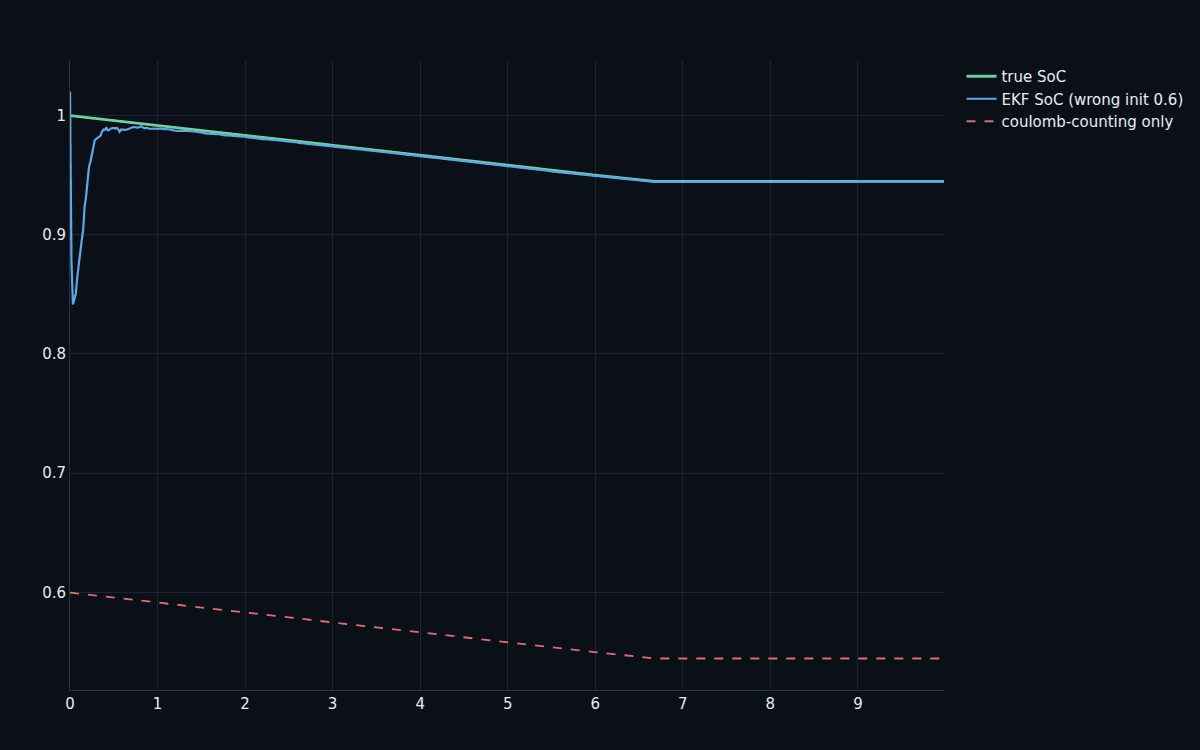
A filter that's confidently wrong is worse than no filter.
The dangerous failure isn't a noisy estimate — it's a wrong one reported with tight confidence. The program makes that explicit: NEES/NIS consistency checks tell you when the filter's claimed uncertainty matches reality; an observability analysis shows a mode the sensors simply can't resolve; and a divergence case has an overconfident filter walk 16 m off truth while claiming 12 cm of error — then fixes it with honest process noise. A χ²-innovation gate rejects 30 m outliers and cuts tracking error 84%.
DjiniousLab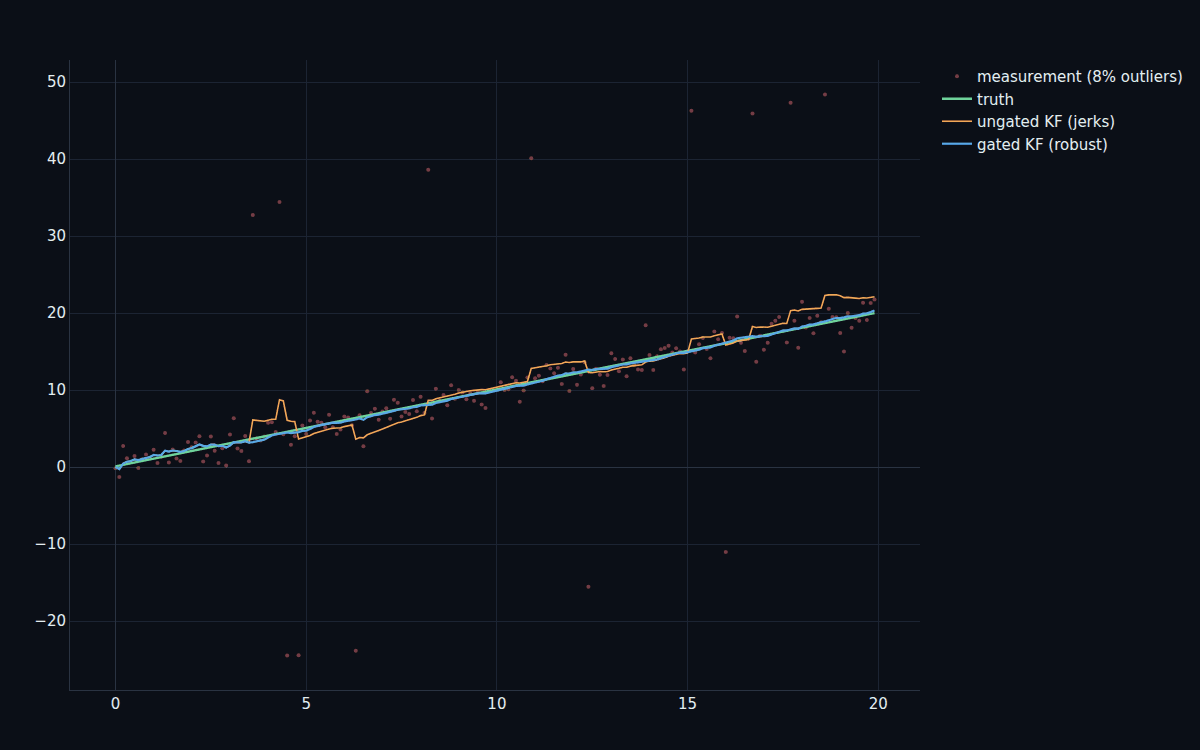
Every number re-derived at sign-off.
The V&V notebook rebuilds each filter from scratch and re-derives the requirements, printing a PASS/FAIL board.
Result
- Linear KF vs raw measurement: 0.22×
- EKF convergence from bad init: 1.10 s
- UKF vs EKF (hard nonlinearity): 0.98×
- Fused GPS+IMU through dropout: 0.28×
- Filter consistency (NEES / NIS): 1.87 / 0.98
Requirement
- Linear KF vs raw measurement: R-01 < 0.5
- EKF convergence from bad init: R-02 < 2 s
- UKF vs EKF (hard nonlinearity): R-03 ≤ 1
- Fused GPS+IMU through dropout: R-04 < 0.5
- Filter consistency (NEES / NIS): R-05
Reproducible filters on idealized sensors.
The deliverable is ten notebooks and the dossier — estimation is a recursive algorithm on sensor data, not an acausal network, so there's no custom block or canvas. The noise is synthetic Gaussian, the IMU and battery sensor models are simplified, and everything is discrete-time; the UKF-vs-EKF margin is modest because these systems are only gently nonlinear, and the coordinated-turn-vs-constant-velocity comparison is close. What the program does deliver is the full estimator family — KF, EKF, UKF, fusion, consistency, observability, divergence, gating — on numbers you can re-run, and it slots straight into the autopilot→Rust-codegen path, because an estimator is exactly the kind of code that has to be certified before it flies.
Keep exploring
Related use cases
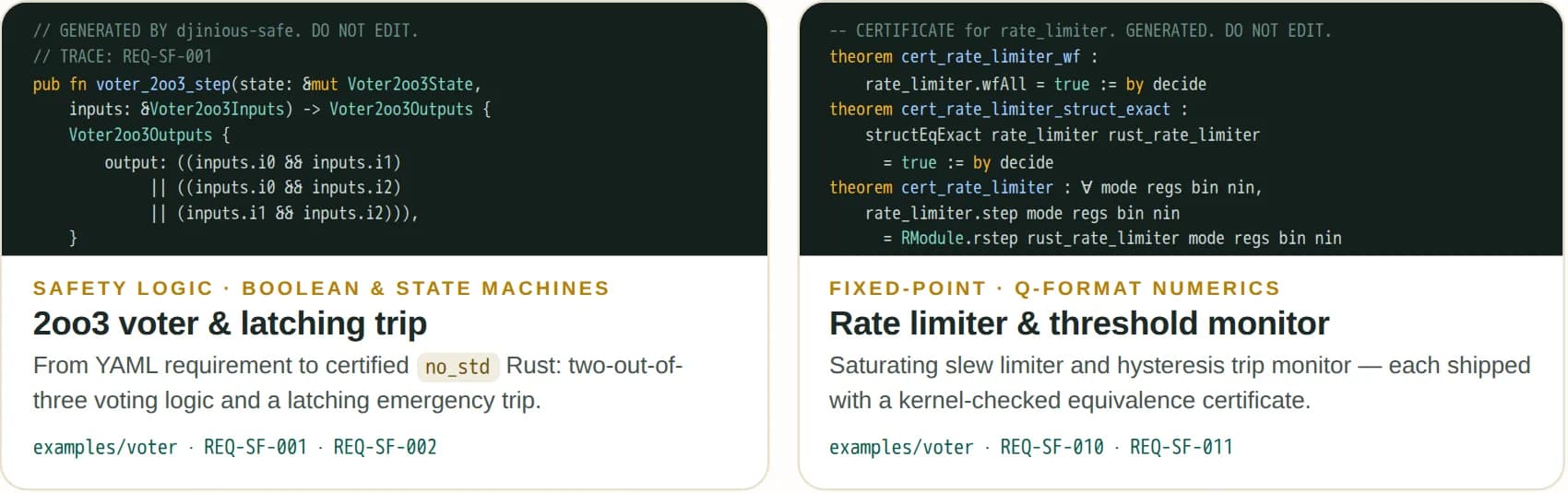 Safety-critical embedded controlNine safety functions, from YAML requirement to certified embedded RustThe voter reference project takes nine safety functions — voting, latching, slew limiting, trip monitoring, interlocks and a flow gauge with a floating-point boundary — through all thirteen gates, and replays every one on an emulated Cortex-M4F.
 DjiniousSafe
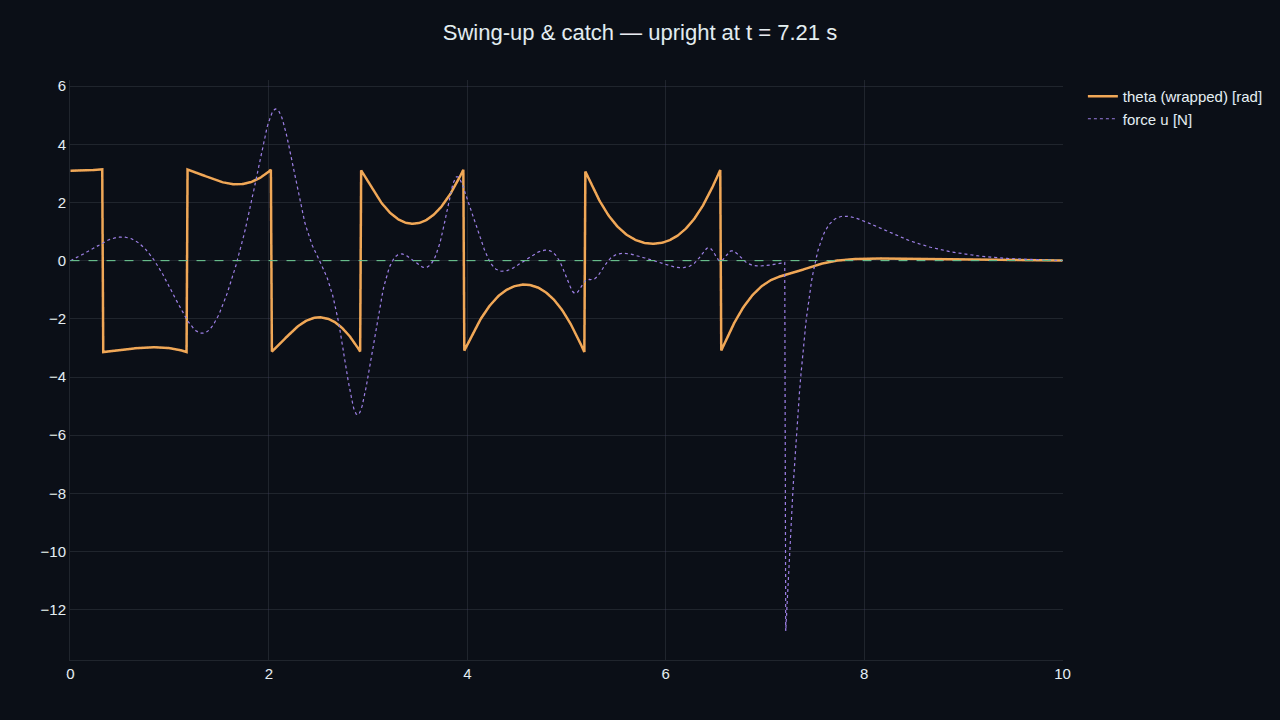 Control & reinforcement learningCart-pole control & RLThe canonical underactuated-control benchmark, taken end to end — nonlinear dynamics, an LQR that stabilises the inverted pole, energy swing-up, a model-free reinforcement-learning policy, and a Monte-Carlo robustness gate.DjiniousLab
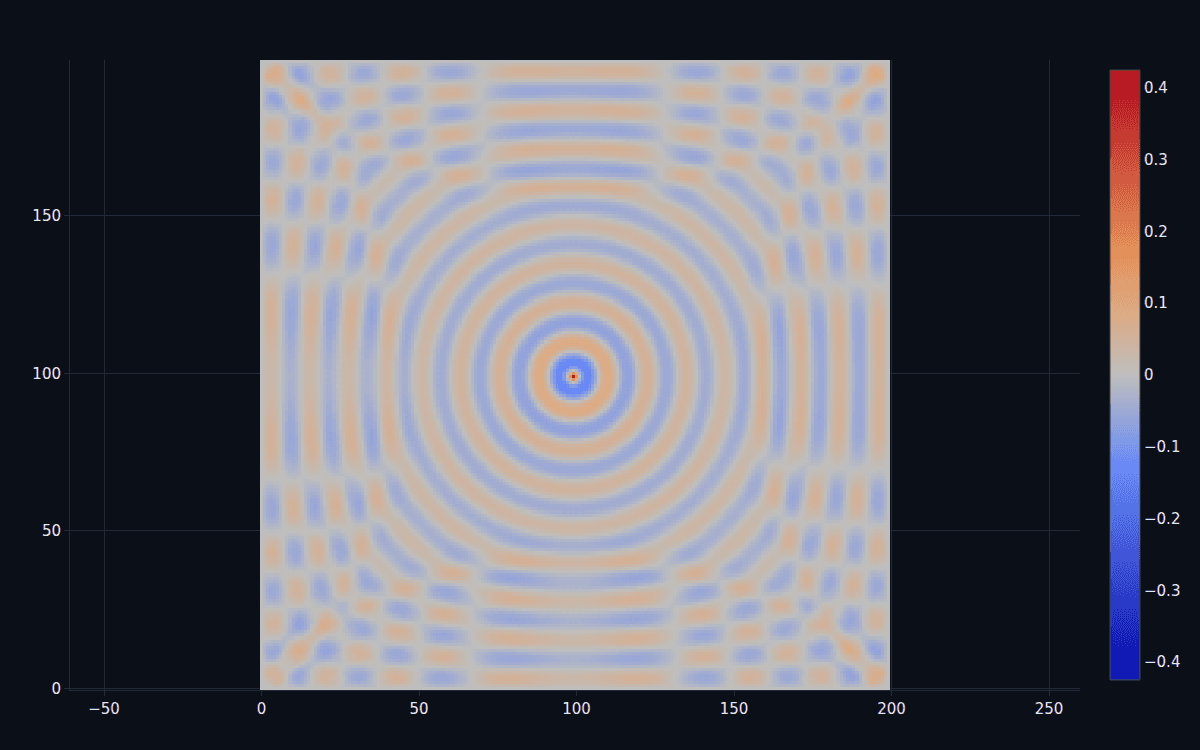 ElectromagneticsElectromagnetics (FDTD)Solving Maxwell's equations on a grid — the electric and magnetic fields leapfrogging through space and time. A self-contained FDTD solver reproduces the canonical wave phenomena: radiation, refraction, diffraction, scattering and cavity resonance. The field-solver sibling to CFD, in electromagnetics.DjiniousLab