 Djinious
Ascent
The rocket equation in 1-DoF then a 3-DoF gravity turn: main-engine cutoff at 38.5 km and Mach-scale speed, 13.5 km downrange at a 65° flight-path angle, max-Q held to 42.6 kPa.
The platform
Each application does one part of the work — and hands its evidence to the next. Use them together, or one at a time.
Platform overviewSee how the loop runs DjiniousEngineeringOrchestration
 DjiniousLabModelling & simulation
 DjiniousWorkshopSystem integration
 DjiniousSafeCertifiable code
 DjiniousWorld3D replicas
 DjiniousMapAgent GIS
 DjiniousCCOperations & SCADA
 DjiniousDataKnowledge base
 DjiniousWorkflowAgent automation
A reusable launch vehicle from liftoff to landing — gravity-turn ascent, staging, a propulsive suicide-burn touchdown, a thrust-vector attitude loop, and a 500-trial landing-dispersion analysis, the descent flown over a 3D globe.
 DjiniousLab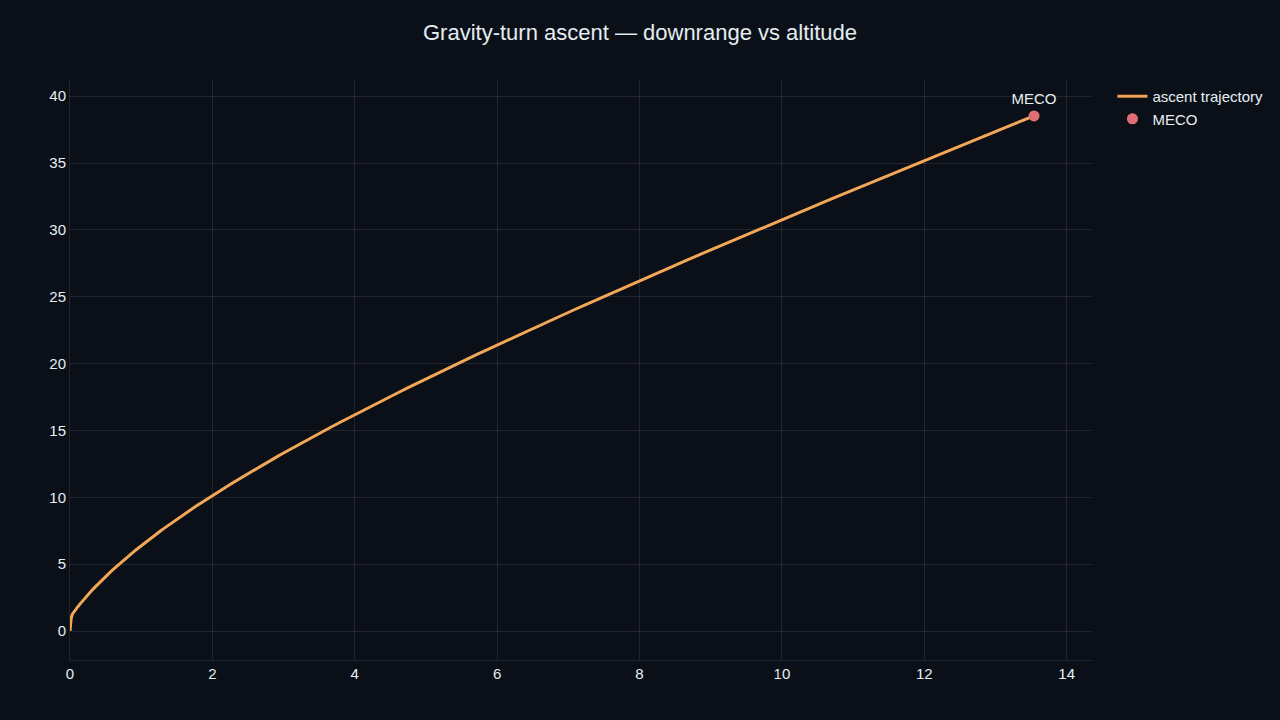
A reusable booster flown end to end: a gravity-turn ascent, main-engine cutoff and staging, then the hard part — a propulsive 'suicide-burn' landing that has to arrive at the pad with zero velocity and zero altitude at once. A thrust-vector attitude loop holds the vehicle steady, and a 500-trial Monte-Carlo bounds where it actually touches down.
Ascent, staging, descent and landing — each a runnable notebook, built up to a full dispersion analysis and a verification gate.
The rocket equation in 1-DoF then a 3-DoF gravity turn: main-engine cutoff at 38.5 km and Mach-scale speed, 13.5 km downrange at a 65° flight-path angle, max-Q held to 42.6 kPa.
Main-engine cutoff at 72 s leaves a ballistic apex of 130.6 km and reserves 1474 kg — about 7% of propellant — for the recovery burns.
The hoverslam: a drag-free estimate says ignite at 939 m, but accounting for descent drag a bisection finds the true ignition altitude at 132 m, arriving at 1.49 m/s with 86% margin.
A thrust-vector control loop gimbals the engine to reject an 8° disturbance and settle to 0.49°, trimming −2.95° against the steady aerodynamic torque.
A 500-trial Monte-Carlo over winds and initial-condition scatter gives a 34.0 m circular error probable and a 67.9 m R95 — the landing-pad sizing number.
The full ascent, boostback and descent rendered as a phase-coloured 3D arc over Cape Canaveral, with a 2D altitude-versus-ground-track companion.
DjiniousLabDjiniousLab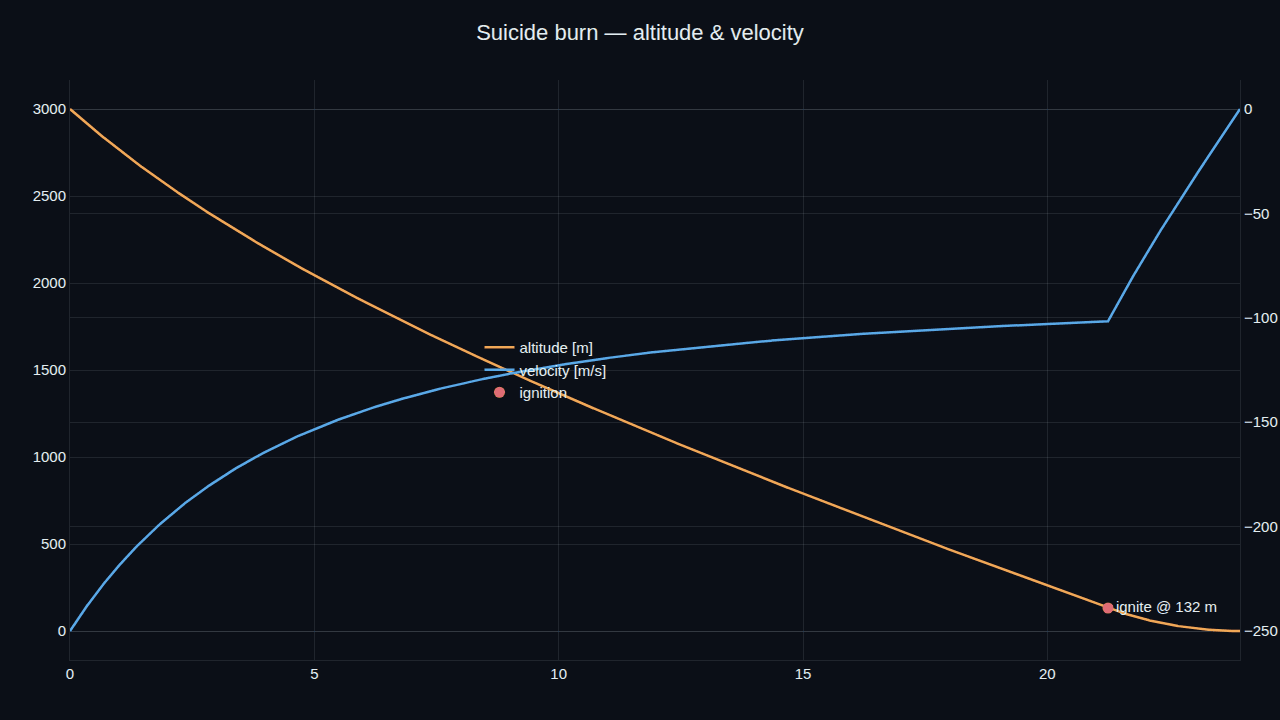
The descent isn't just a velocity profile — the vehicle has to stay pointed. A thrust-vector control loop gimbals the engine against an 8° disturbance and a steady aerodynamic torque, settling the attitude to 0.49° while the landing burn runs. The same model carries the staging energy budget, so the recovery propellant reserved during ascent is the propellant the landing actually spends — the two phases share one set of numbers instead of being signed off in separate tools.
DjiniousLab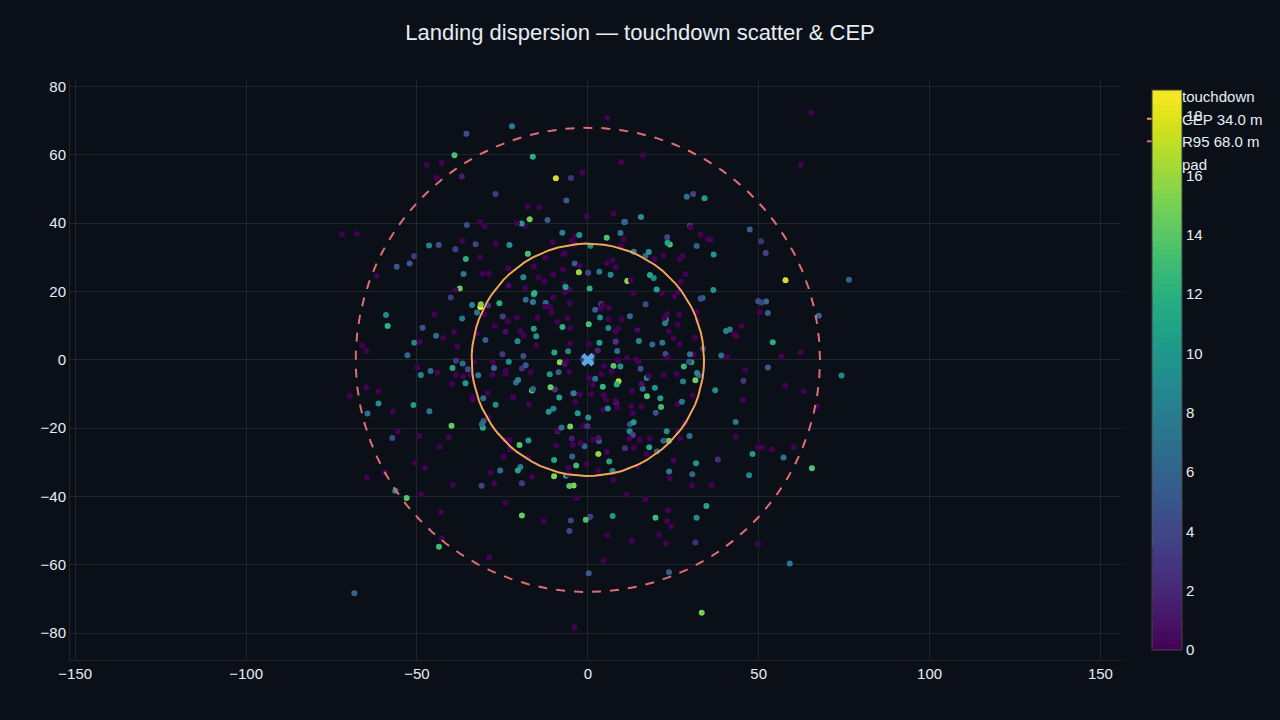
The sign-off notebook re-derives all seven requirements from the same trajectory the design notebooks fly.
The vehicle is a 3-DoF point mass with a single-channel thrust-vector loop and an exponential-atmosphere drag model — not a full 6-DoF model with a Mach-dependent aerodynamic database, Earth rotation, J2, or a flexible-body structural model, and the boostback leg is illustrative. That is the right fidelity for the questions reusability poses first: how much propellant the landing costs, when to ignite the suicide burn, how tight the touchdown dispersion is, and whether the attitude loop holds — answered on your own vehicle numbers, long before a high-fidelity flight simulator is in the loop.
Keep exploring
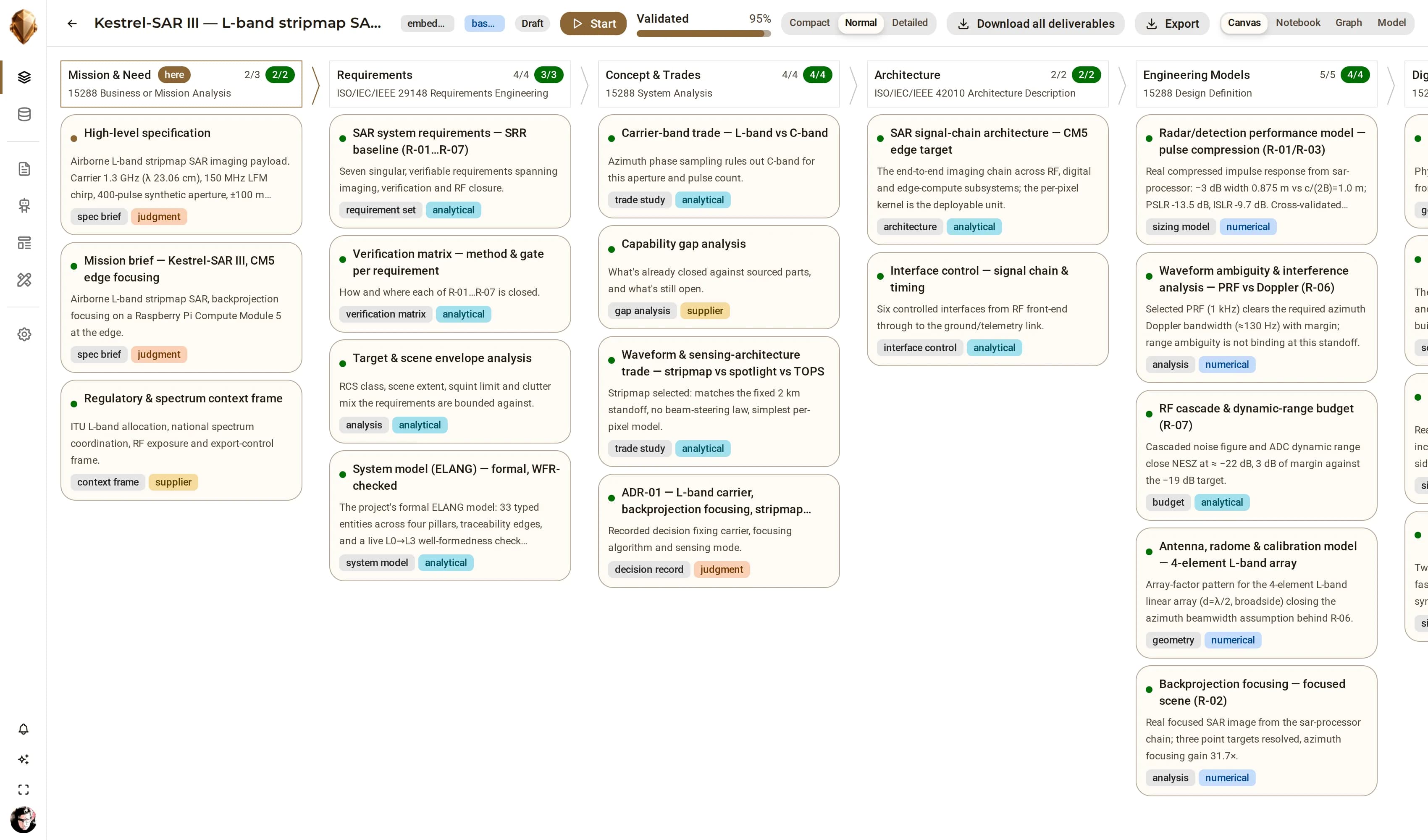 Subsea autonomyMarlin-XR Seabed Survey AUVAn autonomous underwater vehicle surveying the export-cable corridor of the Dogger Bank offshore wind farm. The bundled demo ledger: forty items seeded across all eleven lifecycle stages, from the mission brief to the deployment procedure.
 DjiniousEngineering
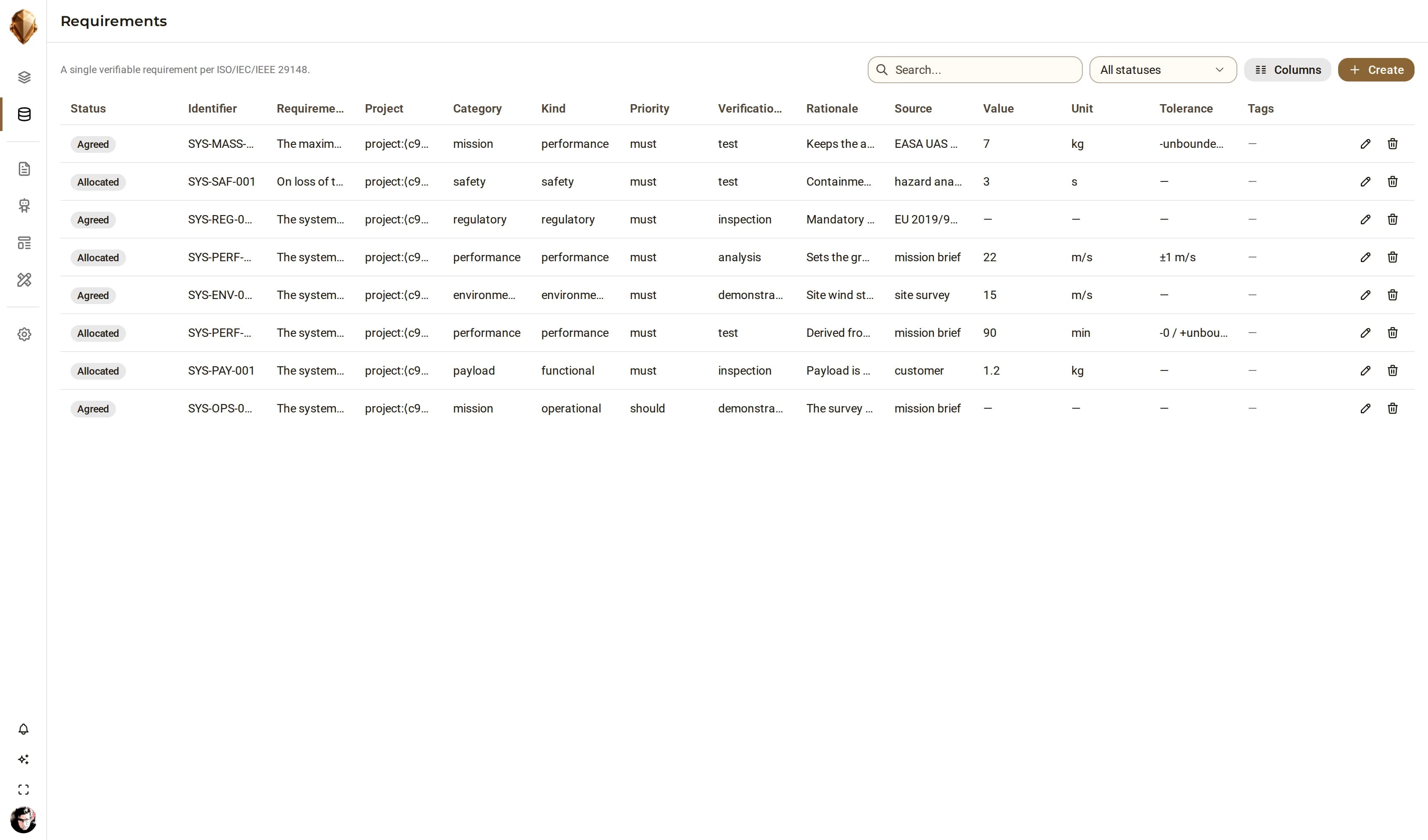 Uncrewed aircraftKestrel-1 Survey UAVA fixed-wing survey UAV, seeded as a worked example: eight requirements, six components, four suppliers and four verifications, wired into a traceability graph, with a real ELANG system_model and an inline Technical Data Package.DjiniousEngineering
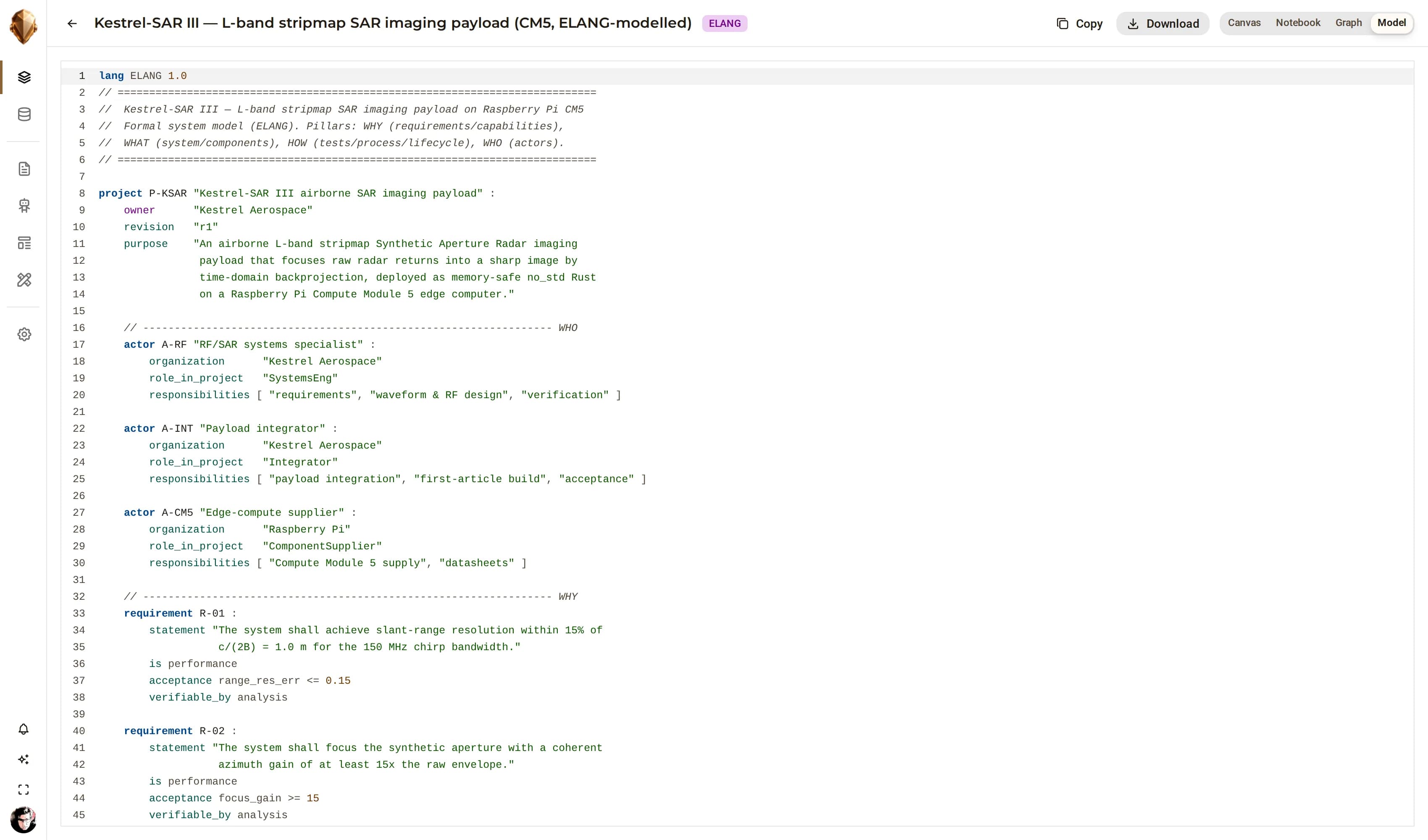 RF & radar sensingEmbedded Radar Sensing ModuleAn embedded radar sensing module — the system class the RF/radar recipe covers: a mixed-signal board where spectrum, EMC, environmental and fabrication standards constrain the design as hard as the sensing requirement does.DjiniousEngineering