 Djinious


Revenue operations
Inbound leads scored and routed in seconds, the pipeline swept every night, and a revenue page that rebuilds itself before the Monday meeting.
 DjiniousWorkflow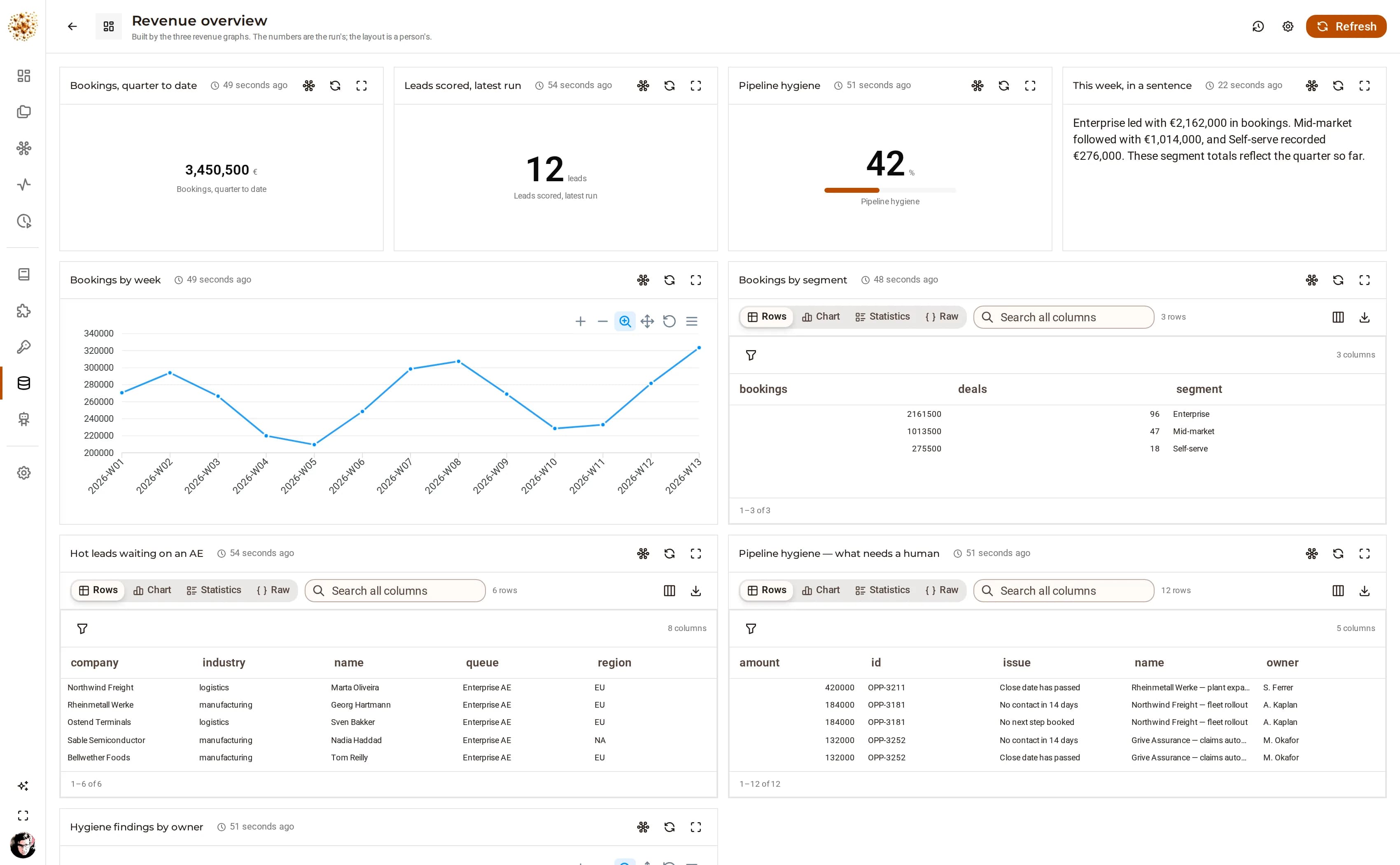
Fan-out · branch and join · scheduled
Every lead is scored on its own event, so a batch of twelve is twelve independent pieces of work that the engine gathers back into one answer. Above the bar the lead goes to an AE with a fifteen-minute SLA; below it, to lifecycle marketing. Both paths write a record.
The nightly sweep asks three questions of the pipeline at once — untouched, no next step, past its close date — and merges the three answers with an all join, which fires once wherever the branches happened to land.
How the graphs run
One event per lead
Score, route, record, gather — none of it in a loop you wrote.
Three filters running concurrently
Merged by a join whose state lives in the database.
A Monday-morning review
It publishes four panels and a written commentary.
A commentary node with an error branch
The page is built even when the model is not reachable.
On the canvas
flow:forEach · flow:collect · flow:merge · views:* · ai:prompt
It ships with the product
This project ships with DjiniousWorkflow. One command seeds it, another runs every graph in it, and the captures here came out of those runs.
Where a graph leans on a fixture rather than a live system, it reads the fixture where your deployment would read a database — swap the node at the top and the rest of the graph does not change. The engine work — the fan-out, the gather, the approval, the publish — is the product’s own.
Keep exploring
Related use cases
 DjiniousDataMaster dataOne customer view from four systems that disagreeCluster the records that describe the same organization, and keep the ones you are not sure about out of the merge.DjiniousDataSite monitoringCounting what a camera sees, not what it detectsObject detection over photos, footage and live streams, materialised as metrics you can alert on.DjiniousData