 Djinious
Orbit propagation
Two-body motion plus the J2 oblateness perturbation, propagated from classical elements — the ground track drifts ~24° west each period as the Earth turns beneath it.
The platform
Each application does one part of the work — and hands its evidence to the next. Use them together, or one at a time.
Platform overviewSee how the loop runs DjiniousEngineeringOrchestration
 DjiniousLabModelling & simulation
 DjiniousWorkshopSystem integration
 DjiniousSafeCertifiable code
 DjiniousWorld3D replicas
 DjiniousMapAgent GIS
 DjiniousCCOperations & SCADA
 DjiniousDataKnowledge base
 DjiniousWorkflowAgent automation
A 24-satellite Walker constellation, designed end to end — orbit propagation with J2, ground tracks and coverage, ground-station contact windows, a fleet-sizing trade, and a verification gate, all over a 3D globe.
 DjiniousLab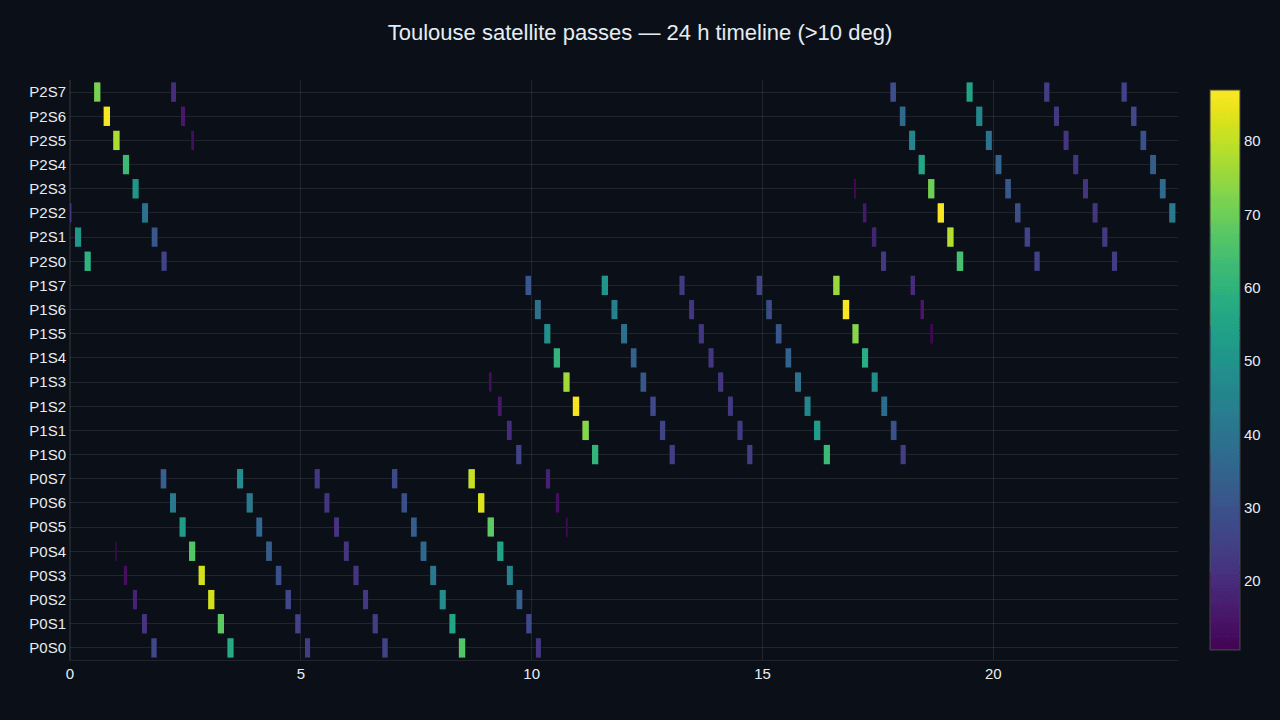
A Walker-delta 24/3/1 constellation at 550 km and 53° inclination — the shape of a modern low-Earth-orbit fleet — propagated with two-body dynamics and J2 nodal precession, its coverage and ground-station contacts worked out over a 3D globe. From a single orbit to a fleet-sizing trade and a verification sign-off, the whole mission-design loop in one program.
Each stage is its own runnable notebook, building from a single propagated orbit up to constellation-level coverage and a sizing trade.
Two-body motion plus the J2 oblateness perturbation, propagated from classical elements — the ground track drifts ~24° west each period as the Earth turns beneath it.
The 24/3/1 recipe places every satellite's RAAN and mean anomaly from the i:T/P/F rule — all 24 orbits rendered at true altitude on the globe, coloured per plane.
An elevation-mask footprint (~15° half-angle, ~1665 km) tiled across the constellation gives a 3D choropleth of how many satellites see each point — and a band coverage near 93%.
For a ground station at Toulouse, every pass above 10° elevation over 24 hours — about 140 passes a day, ~7 minutes mean — laid out as a timeline and an hourly histogram.
A sweep over planes × satellites-per-plane plots fleet size against worst-case revisit, and lands the 24/3/1 baseline at the cost-versus-service knee.
The oblateness-driven node regression of −4.49°/day, separated from the Keplerian baseline and used to search for repeat ground tracks.
DjiniousLabDjiniousLab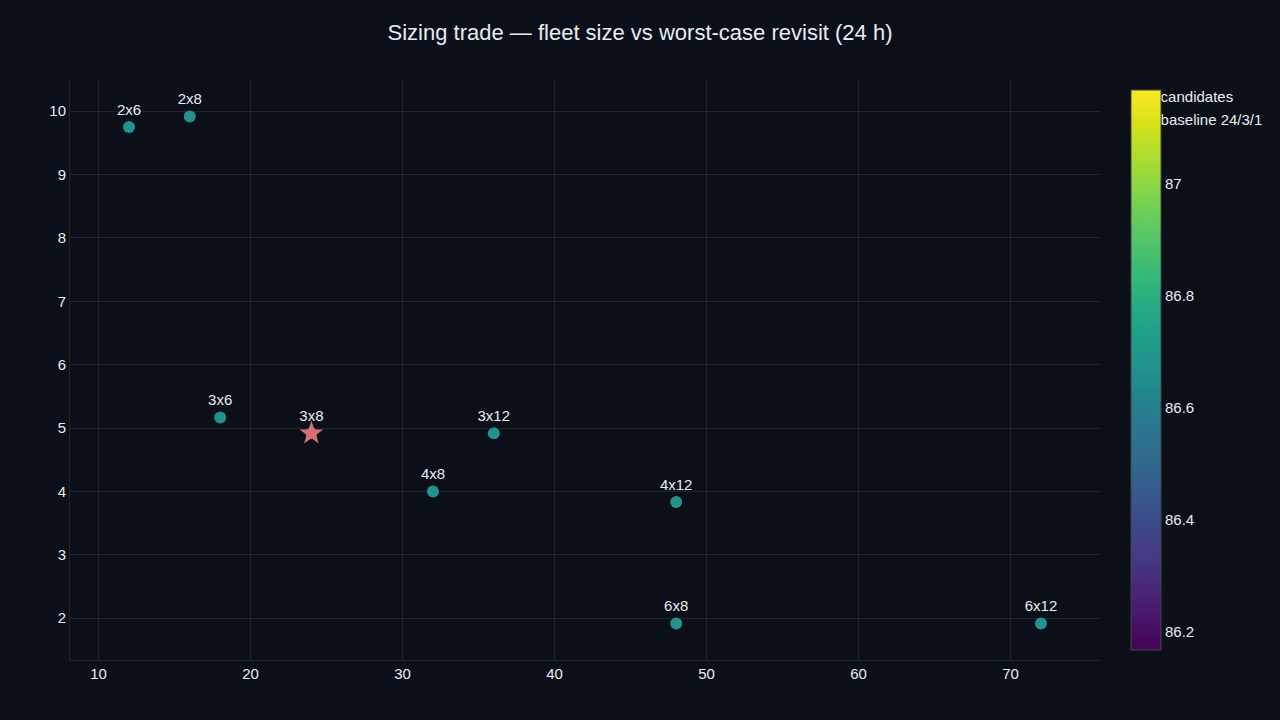
The constellation, its ground tracks and its instantaneous coverage all render on a 3D globe through the same notebook outputs that drive the numbers — orbits at true altitude coloured per plane, footprints extruded by how many satellites are in view. The propagation honours the J2 perturbation, the dominant secular effect at 550 km, so the node regression and repeat-track geometry are physical, not Keplerian idealisations. The mission-design loop — propagate, cover, contact, size, verify — lives in one place instead of three.
DjiniousLab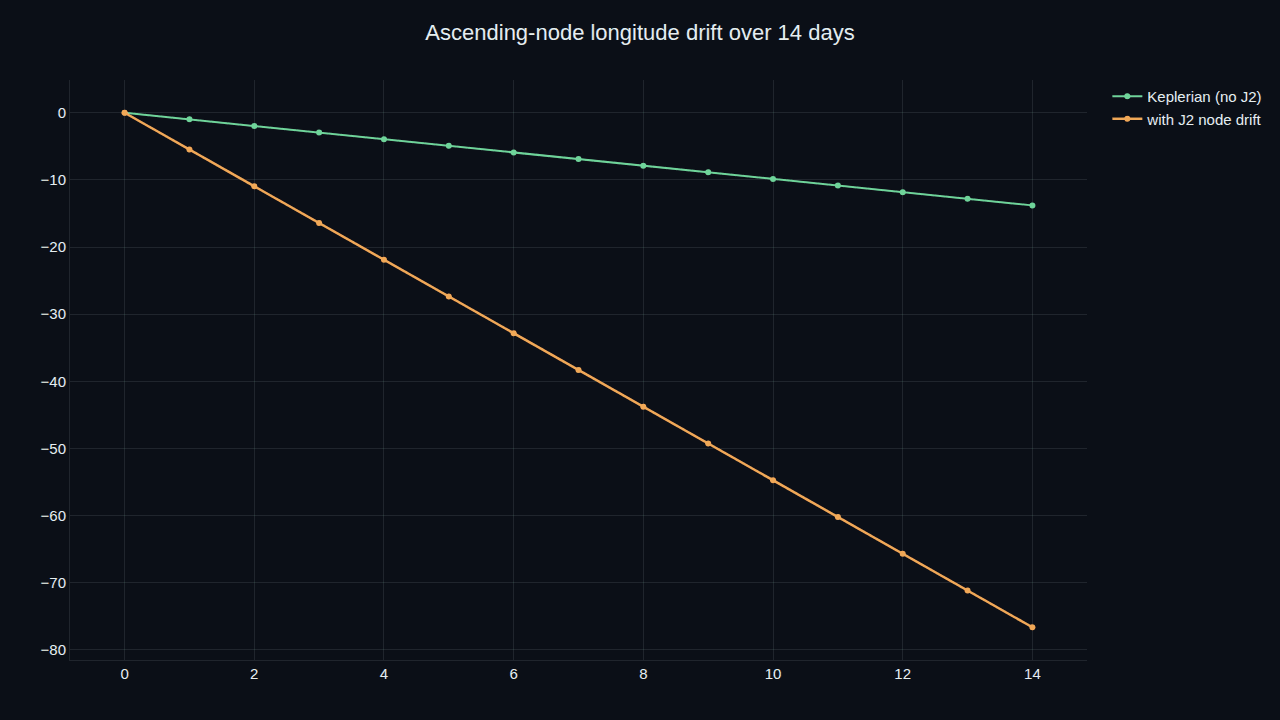
The sign-off notebook re-derives each requirement from the propagated constellation rather than restating the design intent.
Propagation is two-body plus J2 — the dominant secular perturbation at this altitude — not a full force model with drag, higher-order gravity, solar radiation pressure or third-body effects. The coverage footprint is a spherical-Earth elevation-mask cap on coarse grids, and revisit is evaluated over a 24-hour window. That is exactly the fidelity constellation sizing needs first: choosing planes and phasing, checking coverage and revisit, and counting ground-station contacts — before a high-precision orbit-determination tool ever enters the picture.
Keep exploring
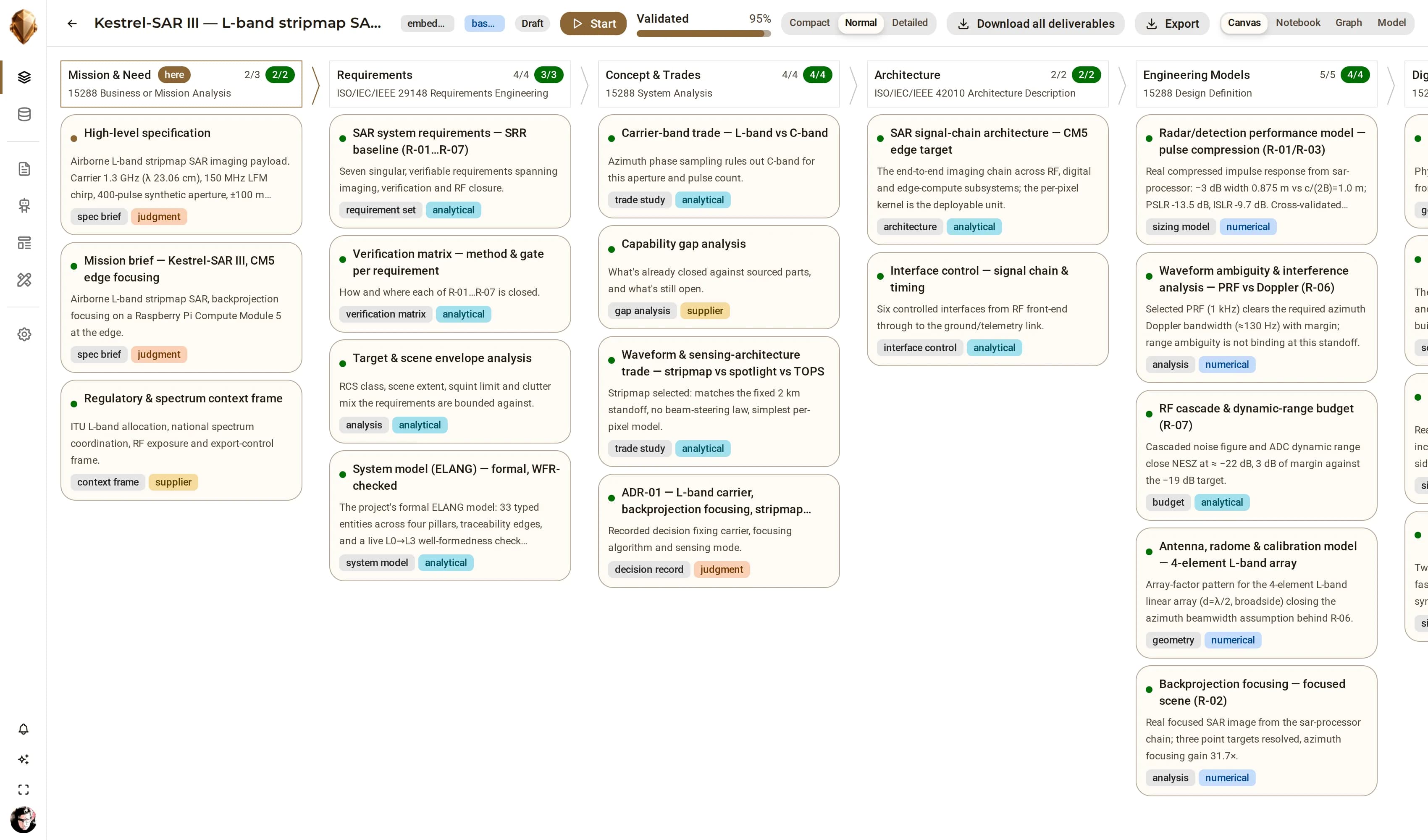 Subsea autonomyMarlin-XR Seabed Survey AUVAn autonomous underwater vehicle surveying the export-cable corridor of the Dogger Bank offshore wind farm. The bundled demo ledger: forty items seeded across all eleven lifecycle stages, from the mission brief to the deployment procedure.
 DjiniousEngineering
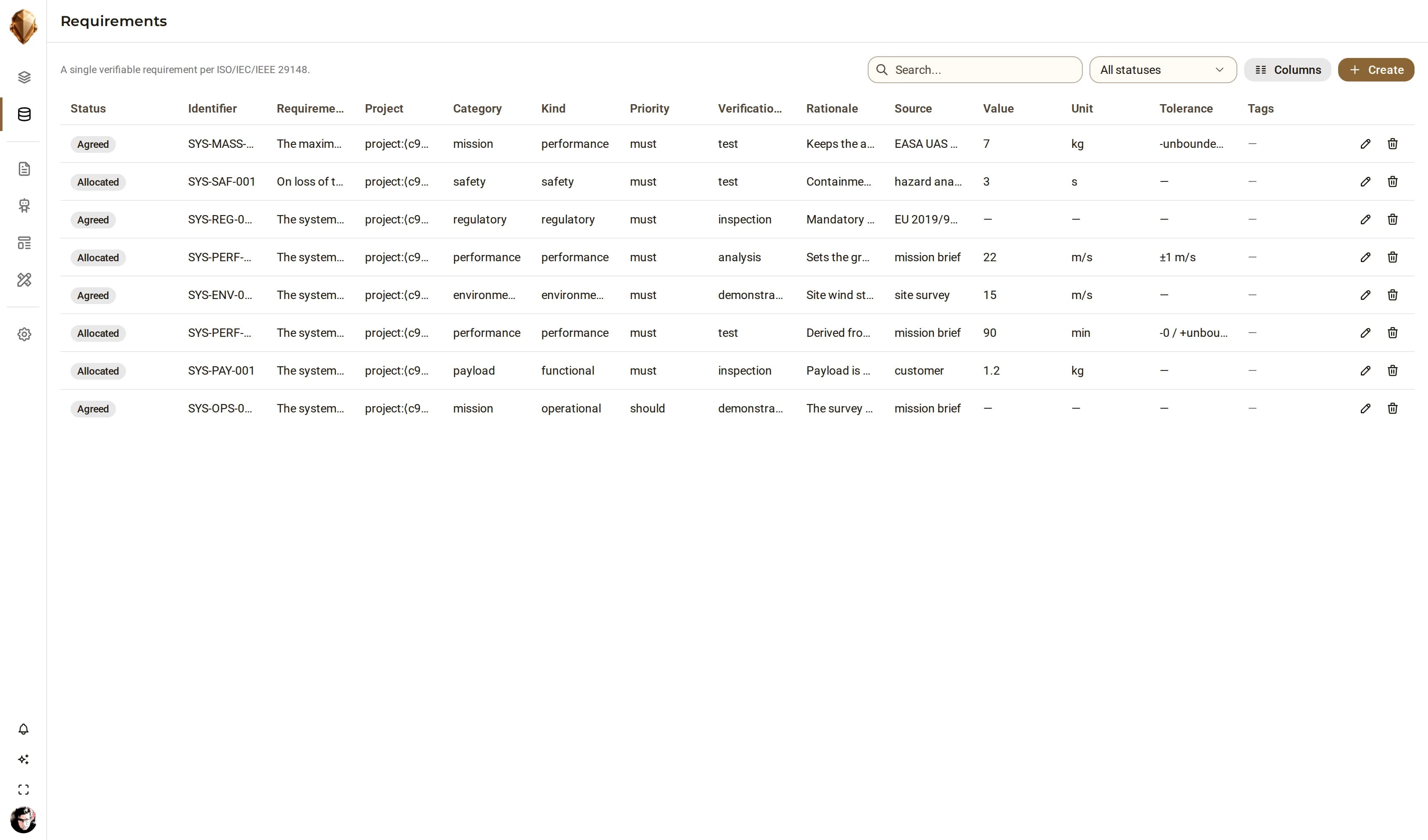 Uncrewed aircraftKestrel-1 Survey UAVA fixed-wing survey UAV, seeded as a worked example: eight requirements, six components, four suppliers and four verifications, wired into a traceability graph, with a real ELANG system_model and an inline Technical Data Package.DjiniousEngineering
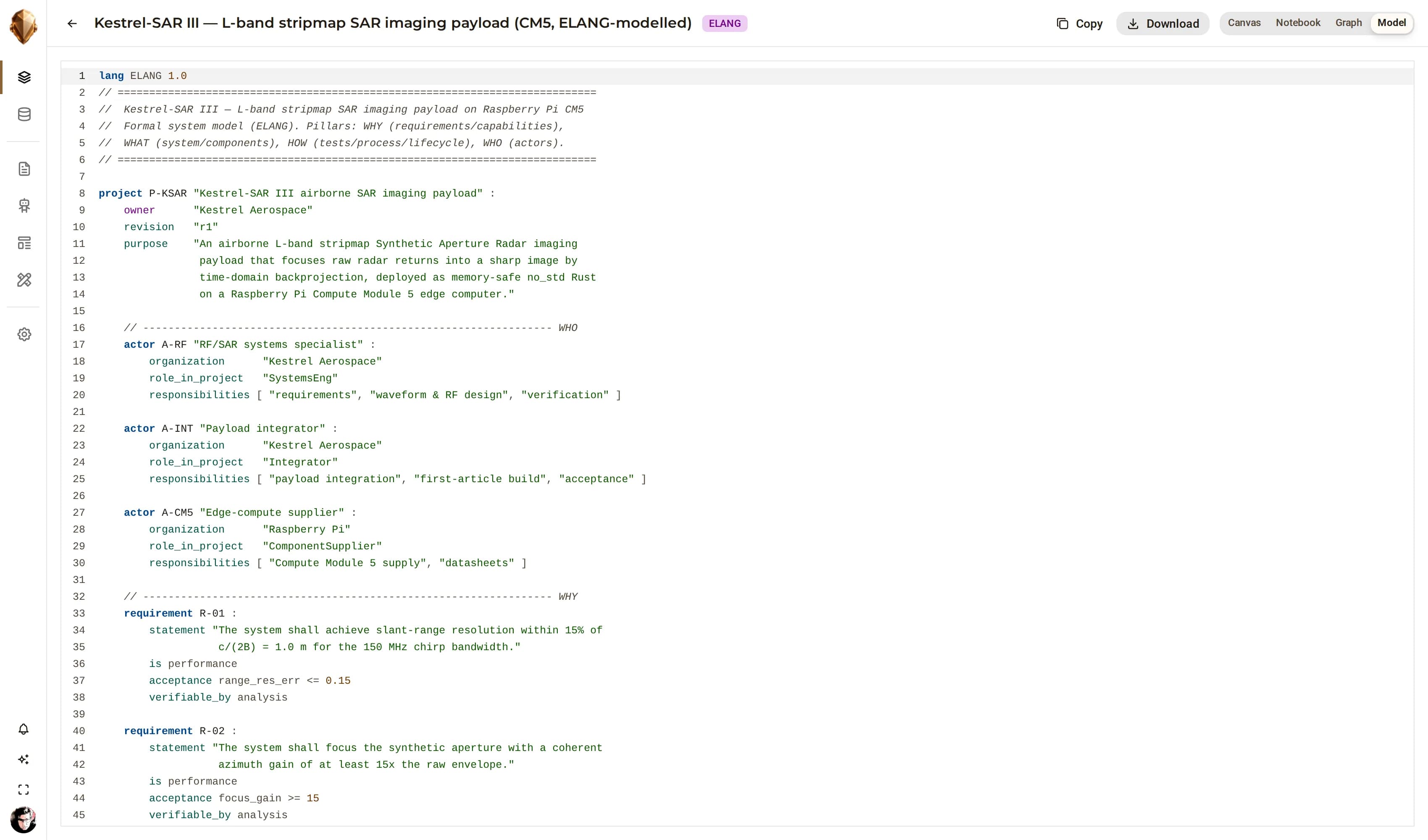 RF & radar sensingEmbedded Radar Sensing ModuleAn embedded radar sensing module — the system class the RF/radar recipe covers: a mixed-signal board where spectrum, EMC, environmental and fabrication standards constrain the design as hard as the sensing requirement does.DjiniousEngineering