 Djinious


Microgrid
Solar PV + wind + battery + grid-tie serving a load as one system under an energy-management controller — composed on a DC bus and run over a day: dispatch, self-sufficiency, peak-shaving, sizing, and islanded stability.
 DjiniousLab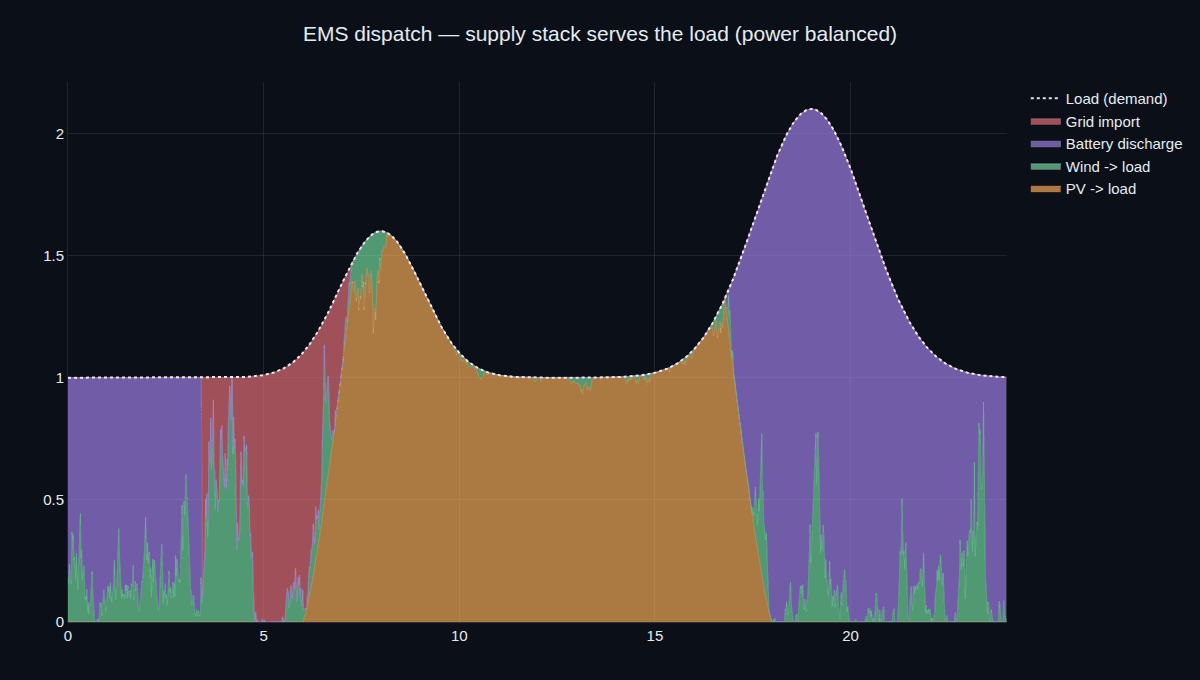
- self-sufficiency
- 91.6%self-sufficiency
- power-balance residual (kW)
- 4.4e-16power-balance residual (kW)
- evening peak shaved
- 48.6%evening peak shaved
- islanded droop dip (1.2 s)
- 0.3 Hzislanded droop dip (1.2 s)
- design notebooks
- 10design notebooks
- .djl composition
- 1.djl composition
Whole energy systems, composed and run.
A microgrid isn't one component — it's a system: solar, wind, a battery, a grid connection and a load, all decided together, minute by minute, by an energy-management controller. This is the program that composes them. It models each source, wires them onto a shared bus, runs the dispatch over a day, and answers what an installer actually asks — how self-sufficient, how much peak shaved, what to size, and does it stay stable when it islands.
Five subsystems, one system.
The microgrid is the clearest demonstration of designing a complete system from parts. Each subsystem carries its own physics — a single-diode PV array with its maximum-power point, a wind turbine power curve, an equivalent-circuit battery, a load profile, a grid tie — and they're wired onto one shared DC bus and solved together as a single acausal electrical network. On top of that bus sits the energy-management strategy that decides, every minute, where each kilowatt comes from and goes: PV to the load first, surplus to the battery, then the grid, then curtail; deficit from the battery, then import.
DjiniousLab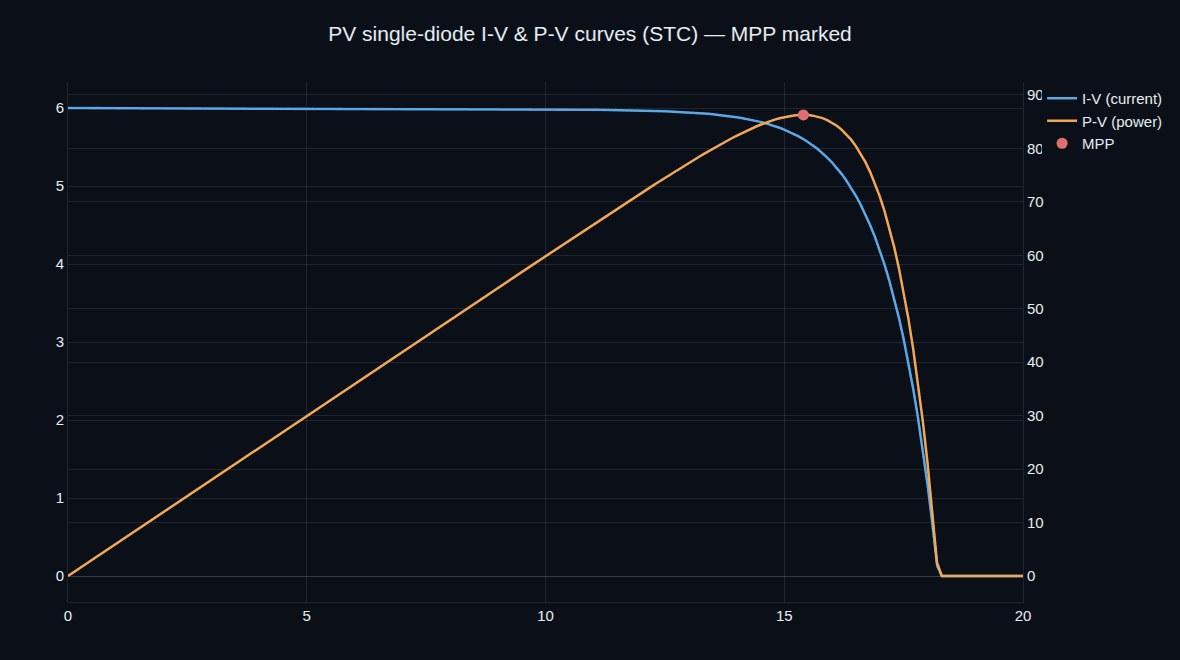 DjiniousLabDjiniousLab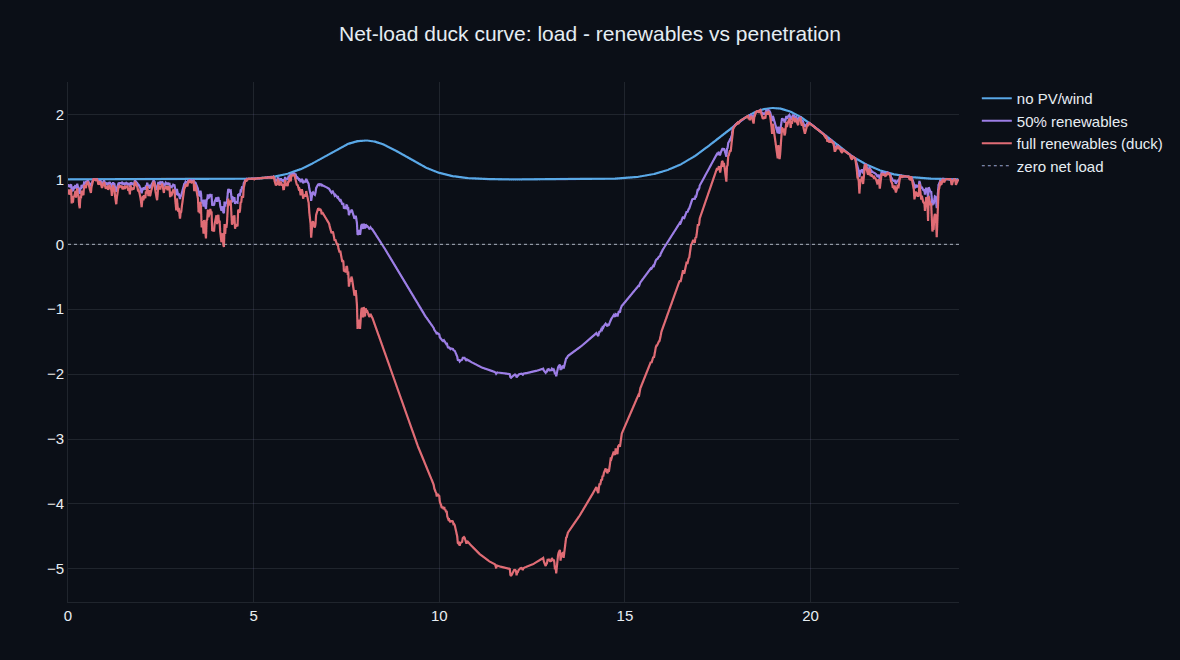
From half off-grid to almost off-grid.
A battery turns a solar system from a daytime helper into a round-the-clock supply. Adding storage lifts self-sufficiency from 50% to 92% — the home draws from the grid only on the dullest mornings — and it shaves the evening import peak nearly in half, soaking up midday surplus and releasing it after sunset. The sizing study maps where that value saturates: the first few kilowatt-hours of storage buy the biggest jump, and there's a clear knee past which more battery barely moves the needle.
DjiniousLab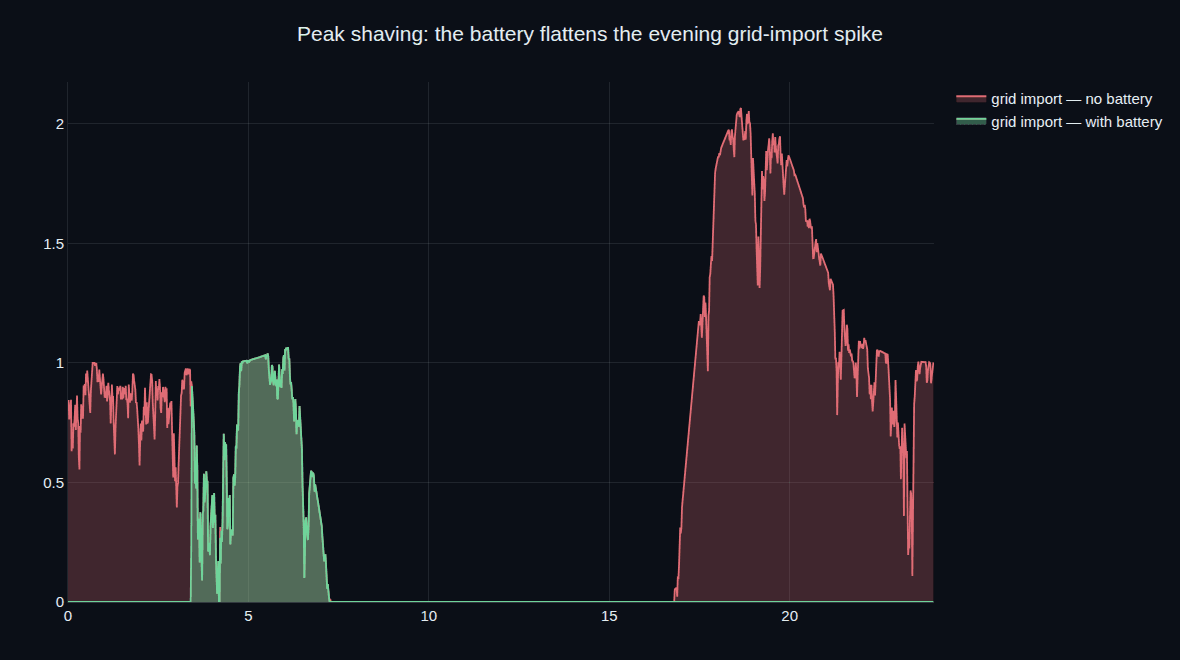 DjiniousLab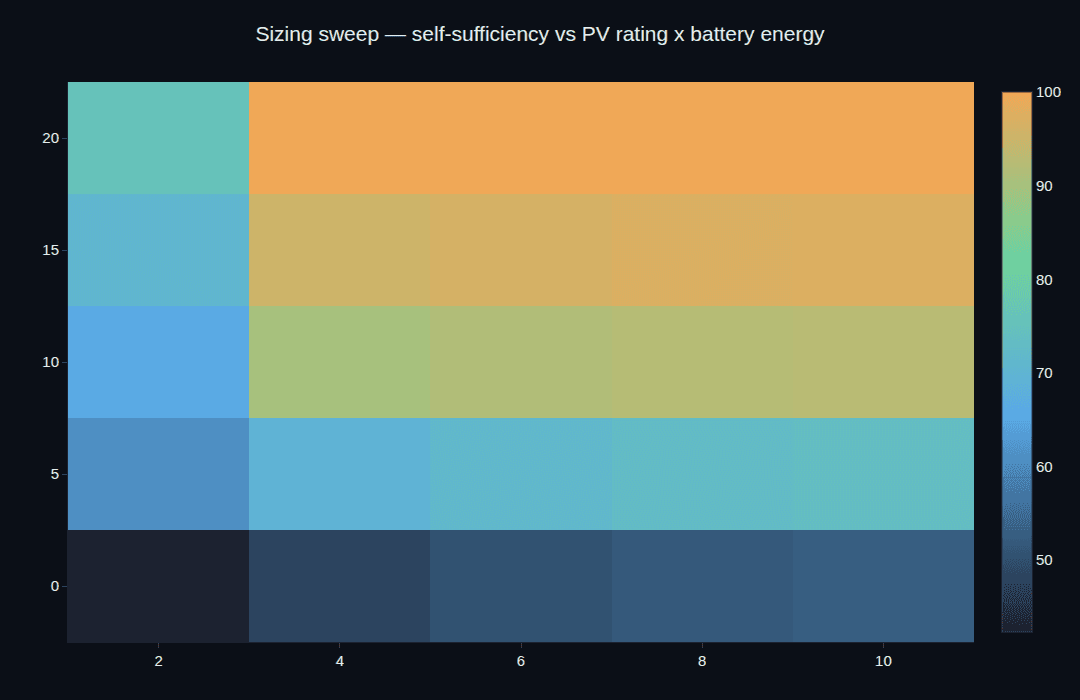
Holding the grid up alone.
Cut the utility connection and the microgrid has to set its own frequency. With droop control, each source contributes in proportion to its rating with no communication between them: a sudden load step drops the frequency, the sources pick it up in exact proportion to their droop slopes, and the frequency settles to a small, bounded offset within a second. It's the primary-control mechanism that keeps an islanded system standing — modelled here, droop slopes and all.
Every number is one you can re-run.
The sign-off notebook re-derives each requirement from the same dispatch the program runs; the composition .djl is confirmed solving through the canvas engine.
Result
- Self-sufficiency (with storage): 91.6%
- Power-balance residual: 4.4e-16 kW
- Self-sufficiency lift from storage: 50.5 → 91.6%
- Evening-peak import cut: 48.6%
- Requirements verified: 5 / 5
Requirement
- Self-sufficiency (with storage): R-01
- Power-balance residual: every step
- Self-sufficiency lift from storage: R-03
- Evening-peak import cut: R-04
- Requirements verified: PASS
Quasi-static dispatch, design-grade.
The dispatch is a quasi-static power balance, not an electromagnetic-transient grid simulation; the energy management is a transparent rule-based strategy, not an optimal/MPC dispatch; the islanded-stability notebook uses averaged primary droop (secondary frequency restoration is noted as future work); the daily profiles are synthetic and the economics indicative. That is exactly the fidelity microgrid concept and sizing need first — choosing PV, wind and battery sizes, designing the dispatch, quantifying self-sufficiency and peak-shaving, and checking islanded stability — on your own load and resource data, before a detailed EMT or optimal-dispatch study. And the DC-bus .djl shows the same system composed on a canvas.
Keep exploring
Related use cases
 Grid-scale energySunnyGrid80 Solar-Storage PlantAn 80 MW photovoltaic plant with a 40 MW / 80 MWh battery energy-storage system and its grid substation, modelled in ELANG as an audited reference to UL 9540A and IEC 62443 — a system-of-systems where the interfaces carry as much of the design as the boxes.
 DjiniousEngineering
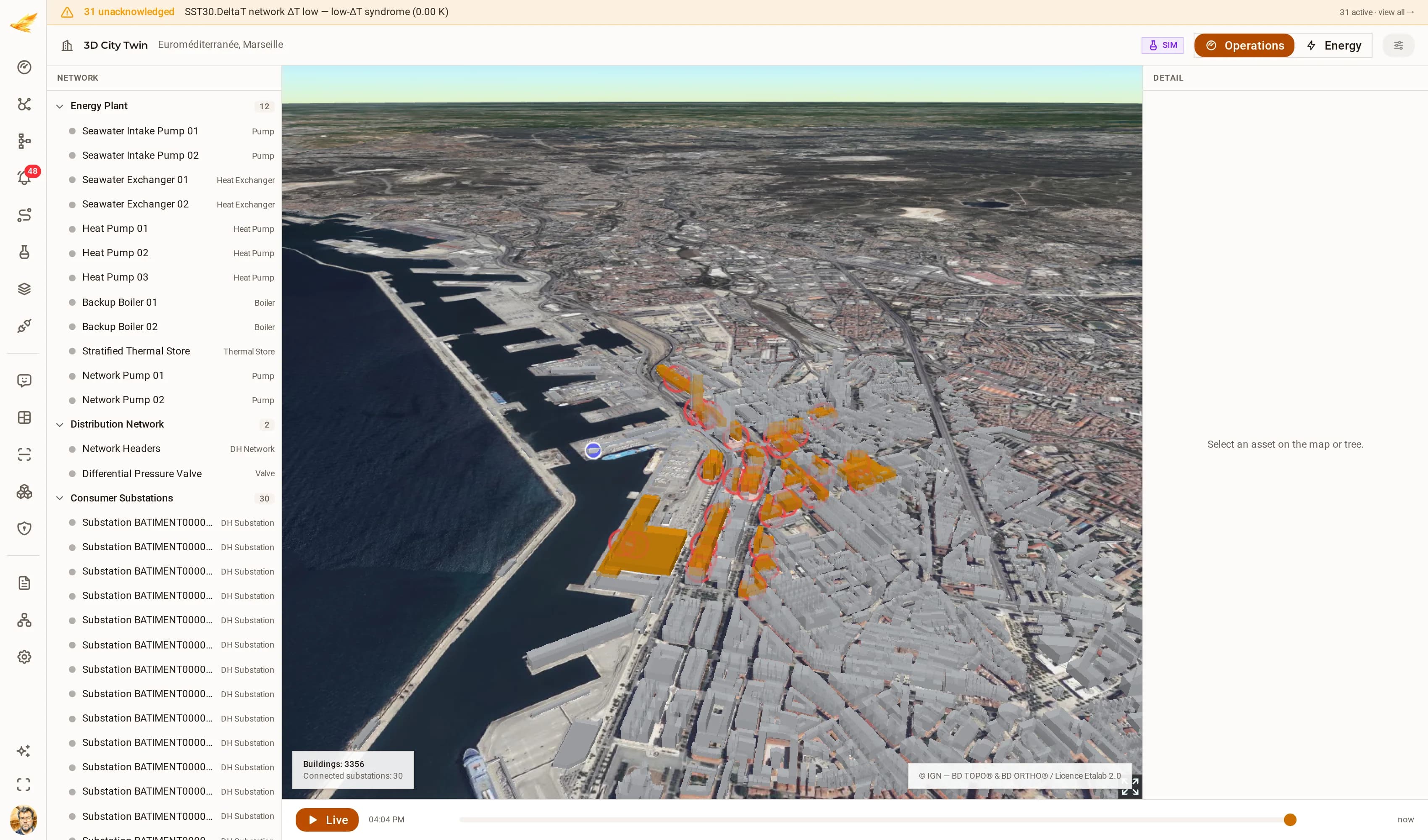 District energyEuroméditerranée District Energy NetworkA seawater-source district-heating network: two intake pumps and two seawater exchangers feeding three heat pumps, two backup boilers and a stratified thermal store, distributing through two network pumps and a differential-pressure valve to thirty consumer substations. The network is simulated; the city under it is not — every substation sits on its real IGN BD TOPO® building footprint in the Euroméditerranée quarter. It is a demonstration network on open data, not any operator's plant.
 DjiniousCC
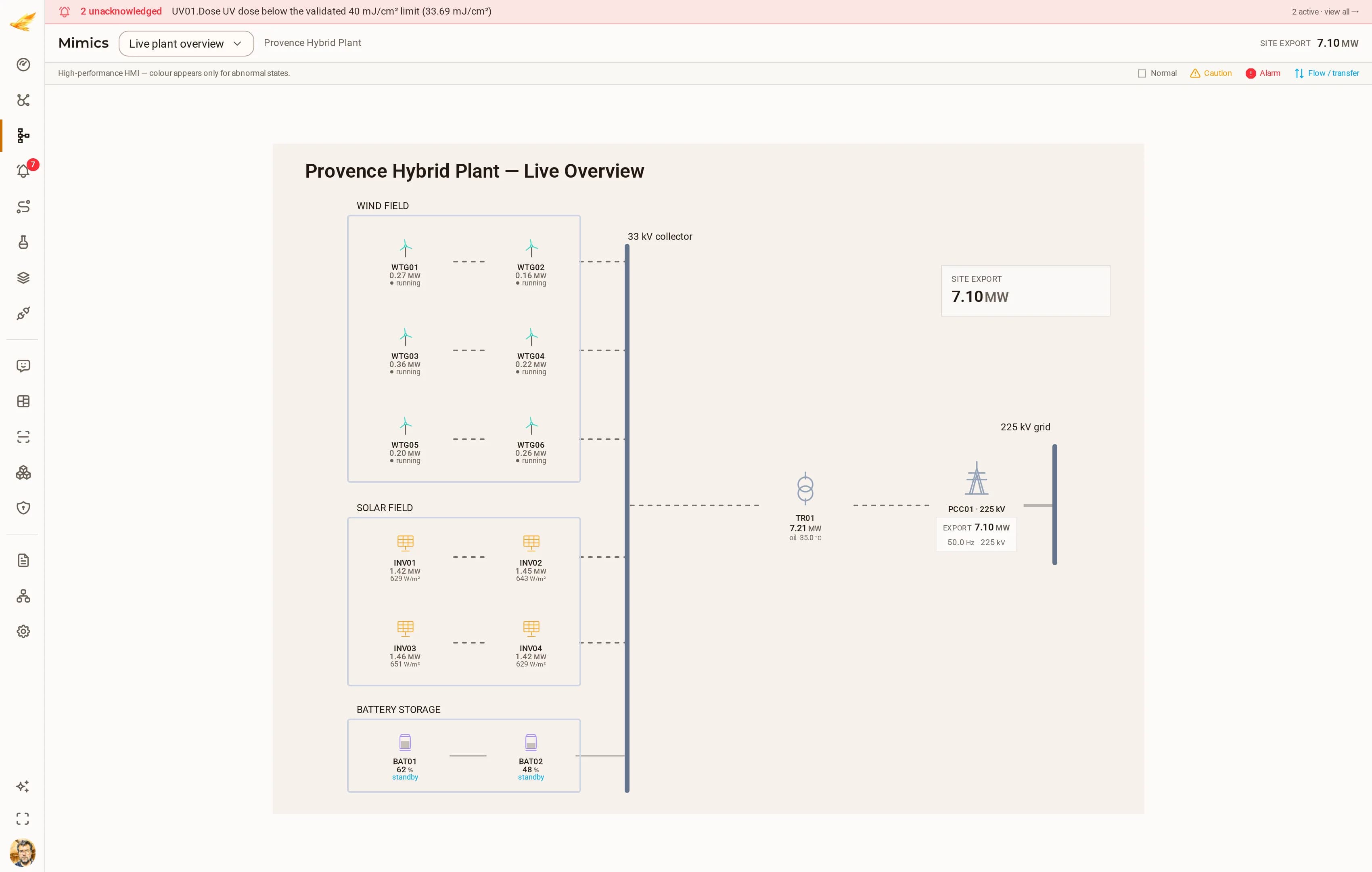 Renewable generationProvence Hybrid PlantA 120 MW hybrid plant: six wind turbines, four PV inverter blocks, two battery racks, the main 33/225 kV transformer, the grid connection point and a meteorological mast.DjiniousCC