 Djinious


Euroméditerranée District Energy Network
A seawater-source district-heating network: two intake pumps and two seawater exchangers feeding three heat pumps, two backup boilers and a stratified thermal store, distributing through two network pumps and a differential-pressure valve to thirty consumer substations. The network is simulated; the city under it is not — every substation sits on its real IGN BD TOPO® building footprint in the Euroméditerranée quarter. It is a demonstration network on open data, not any operator's plant.
 DjiniousCC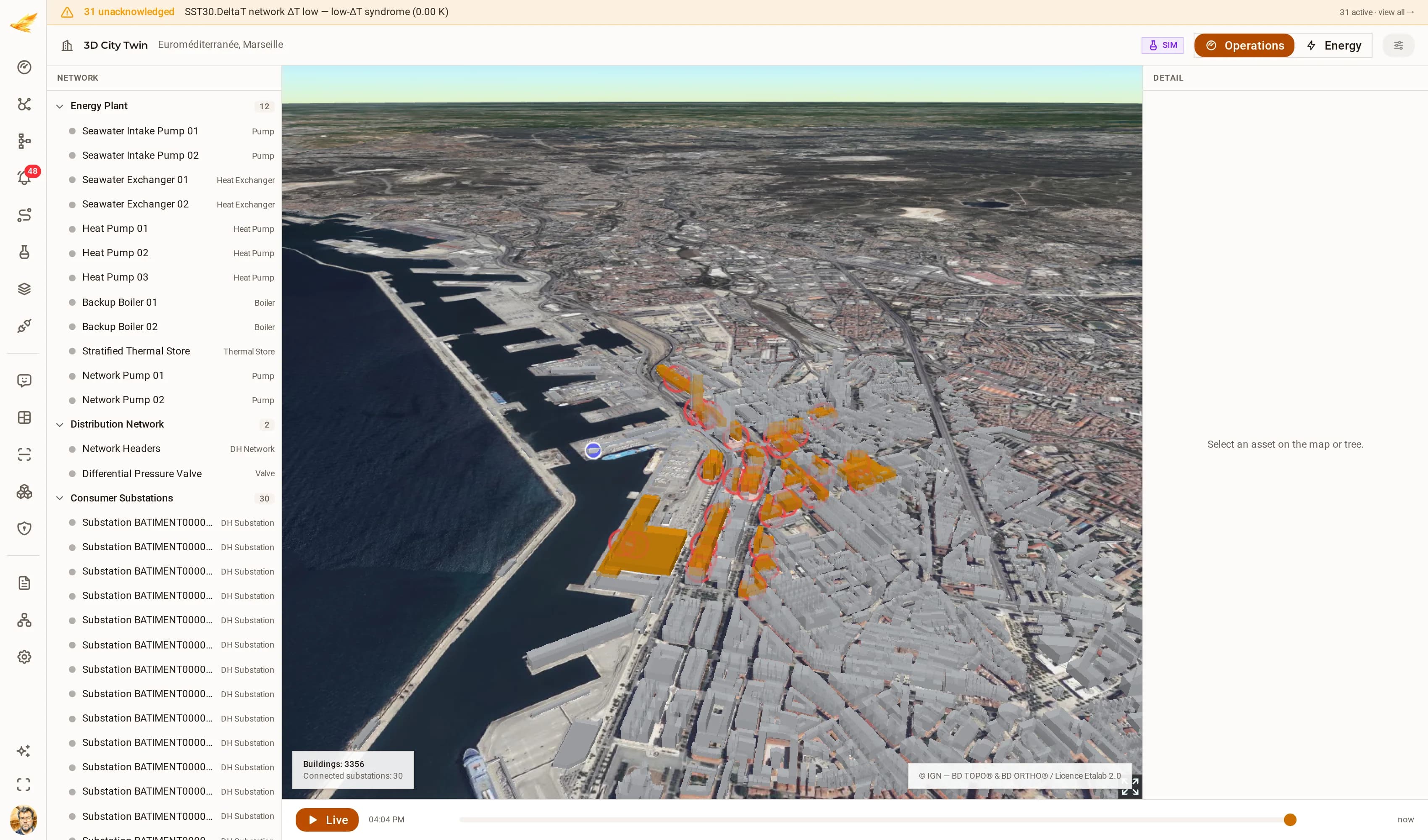
- site code
- MEDIsite code
- assets
- 44assets
- live tags
- 301live tags
- authority class
- C4authority classoperational action
Site MEDI, Marseille, France. These are not mock-ups: all five sites run side by side in the same DjiniousCC instance — 99 assets and 693 live tags, acquired at 1 Hz, historised, alarmed, and each with a procedure that has been dry-run and proven on an isolated twin.
A cold snap asks for more heat than the network was built to deliver
The thirty substations sum to 1,319,287 W/K of heat-loss coefficient. At −4 °C that demands far more than the plant's installed capacity — three heat pumps derated by seawater temperature, two 1,800 kW boilers and a store that can only discharge at 2,000 kW. The supply header sags 21.2 K below its compensation setpoint and every substation downstream starves. You cannot serve everyone; you have to decide who gets trimmed, and be able to show why.
What the platform models here
Each family has a behavioural model that the live simulator and the proving twin share, so a dry-run behaves the way the plant does.
Seawater intake pumps · Seawater exchangers · Heat pumps · Backup boilers · Stratified thermal store · Network pumps · Differential-pressure valve · Consumer substations
The procedure: District Peak Shaving
Carry the network through a cold-snap capacity shortfall without letting the supply header collapse: bring on backup boilers, discharge the store, raise the compensation curve, then stage valve-limit setbacks across the lowest-criticality substations. Authority class: C4 · operational action.
Step 1
Start backup boiler B01
Step 2
Raise supply compensation curve → +6 K
Step 3
Duty-engineer confirmation
Step 4
Stage 1 setback — SST16…SST30 valve limit 70 % (fifteen substations, one command each)
Step 5
Notify control room
The proof: Cold Snap Capacity Shortfall
Ambient falls from +2 °C to −4 °C five minutes into a thirty-minute run, on a seeded clock — the same snap, tick for tick, every time it is run.
Baseline — without the procedure
- Supply header ≥ 67 °C — measured 61.63 °C
- Peak capacity shortfall ≤ 23 000 kW — measured 24 145 kW
- Six largest substations hold ≥ 23 K ΔT — measured 19.93 K
With the procedure — every assertion holds
- Supply header ≥ 67 °C — measured 72.50 °C
- Peak capacity shortfall ≤ 23 000 kW — measured 22 419 kW
- Six largest substations hold ≥ 23 K ΔT — measured 27.66 K
Seventeen commands intercepted on the isolated twin. Note what this does not claim: a 22,419 kW shortfall remains after mitigation. This is peak shaving, not peak solving — the network is genuinely undersized for this snap, and the procedure's job is to hold the header up and triage the load, which the measured numbers show it doing.
What the control room sees
DjiniousCC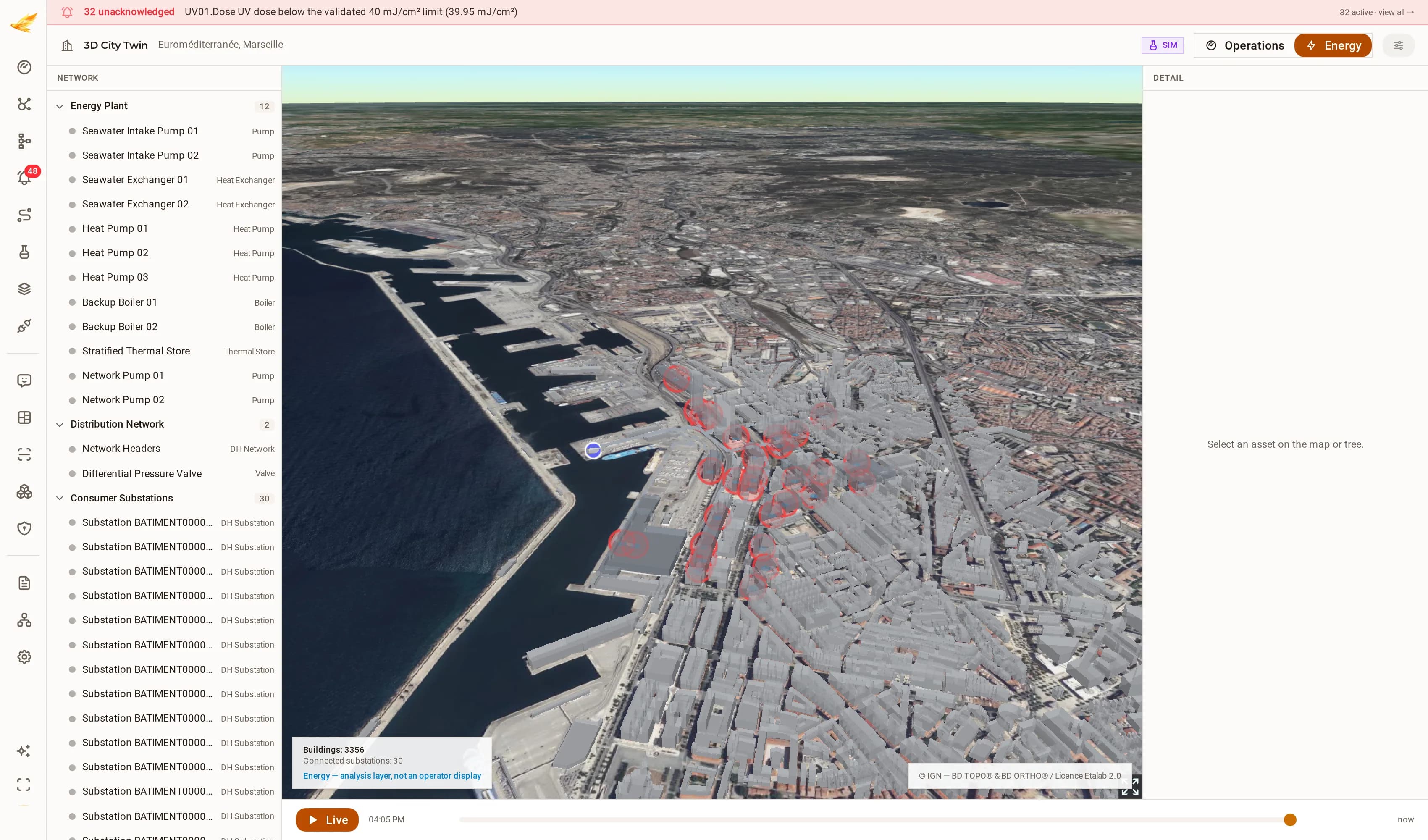 DjiniousCC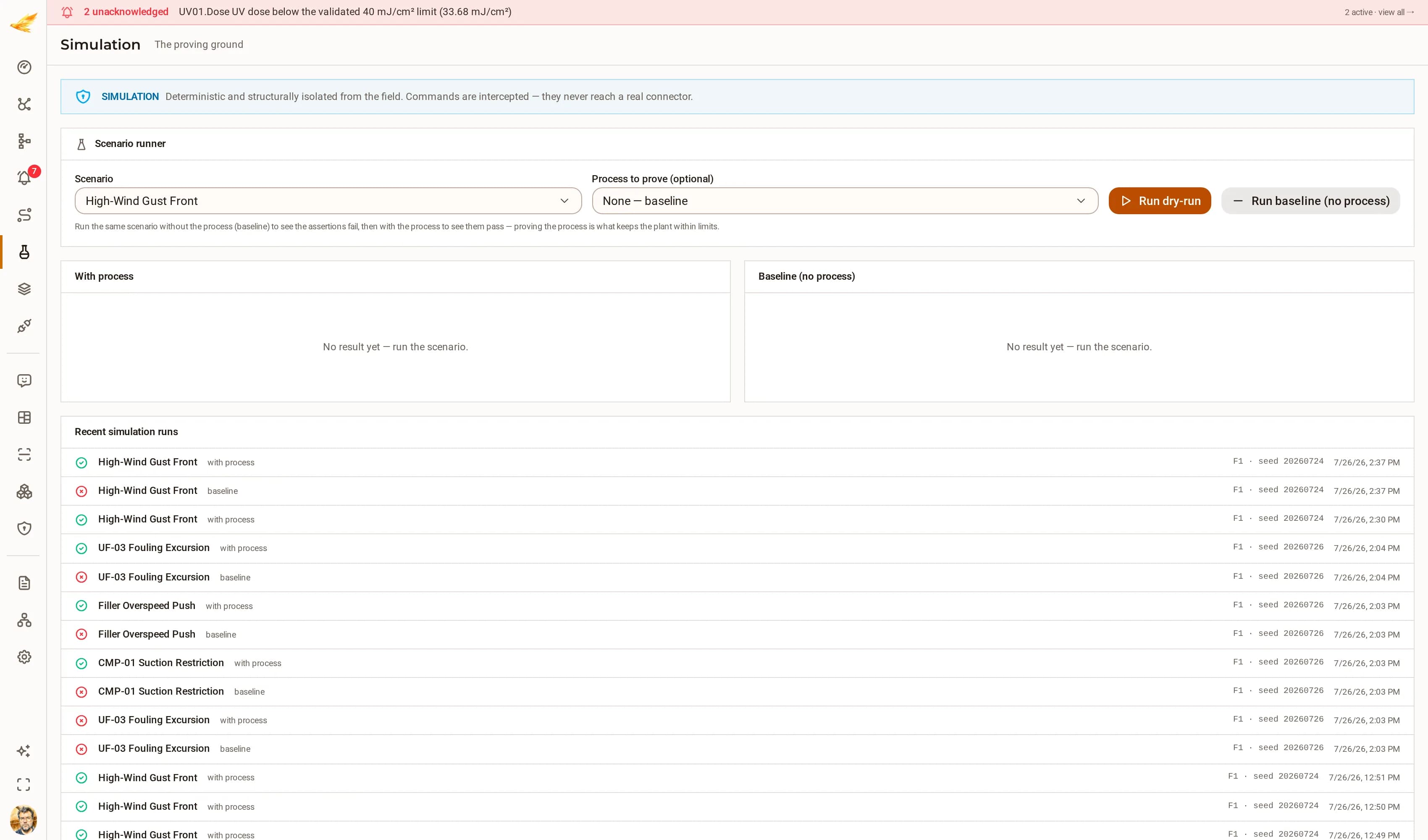
Keep exploring
Related use cases
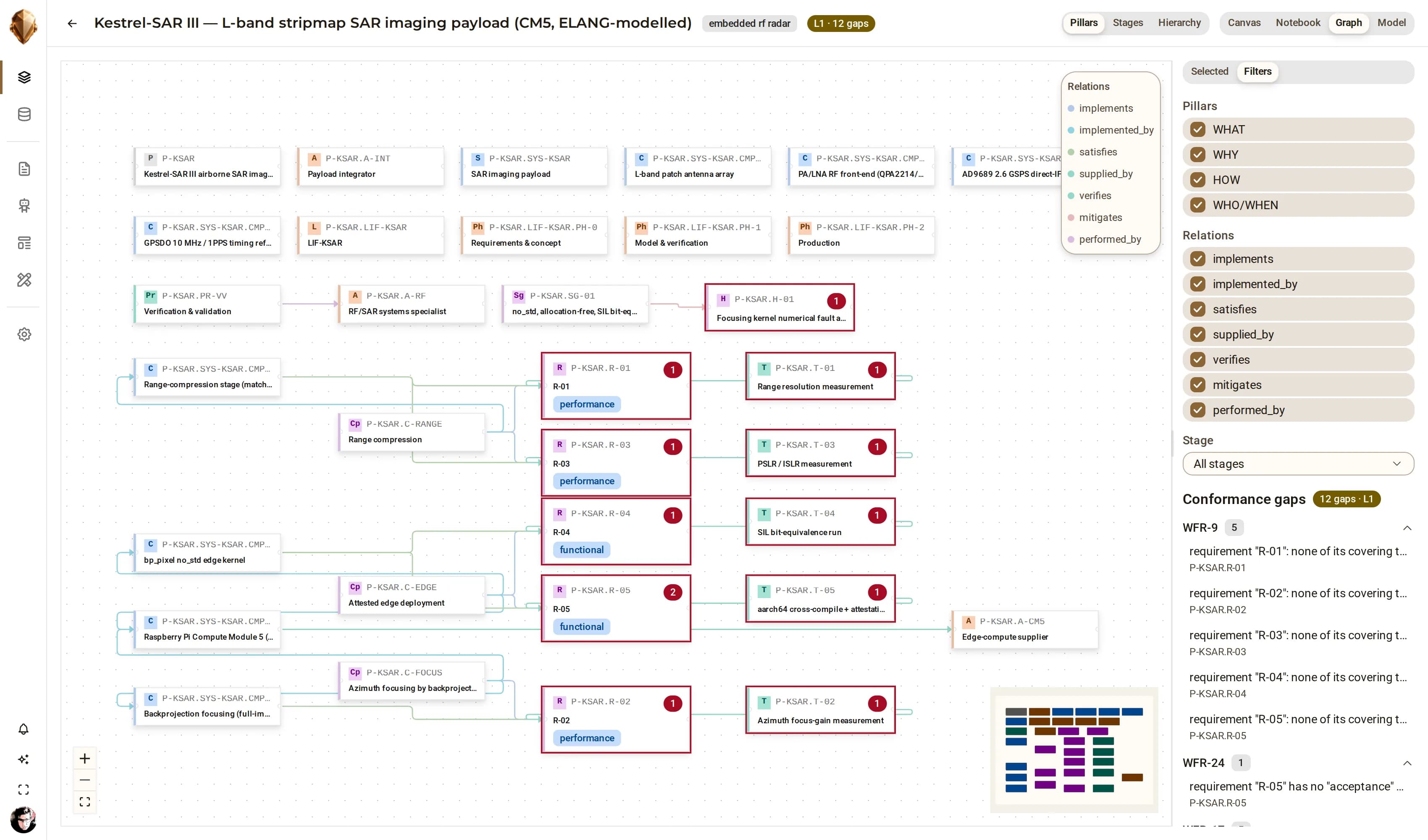 Grid-scale energySunnyGrid80 Solar-Storage PlantAn 80 MW photovoltaic plant with a 40 MW / 80 MWh battery energy-storage system and its grid substation, modelled in ELANG as an audited reference to UL 9540A and IEC 62443 — a system-of-systems where the interfaces carry as much of the design as the boxes.
 DjiniousEngineering
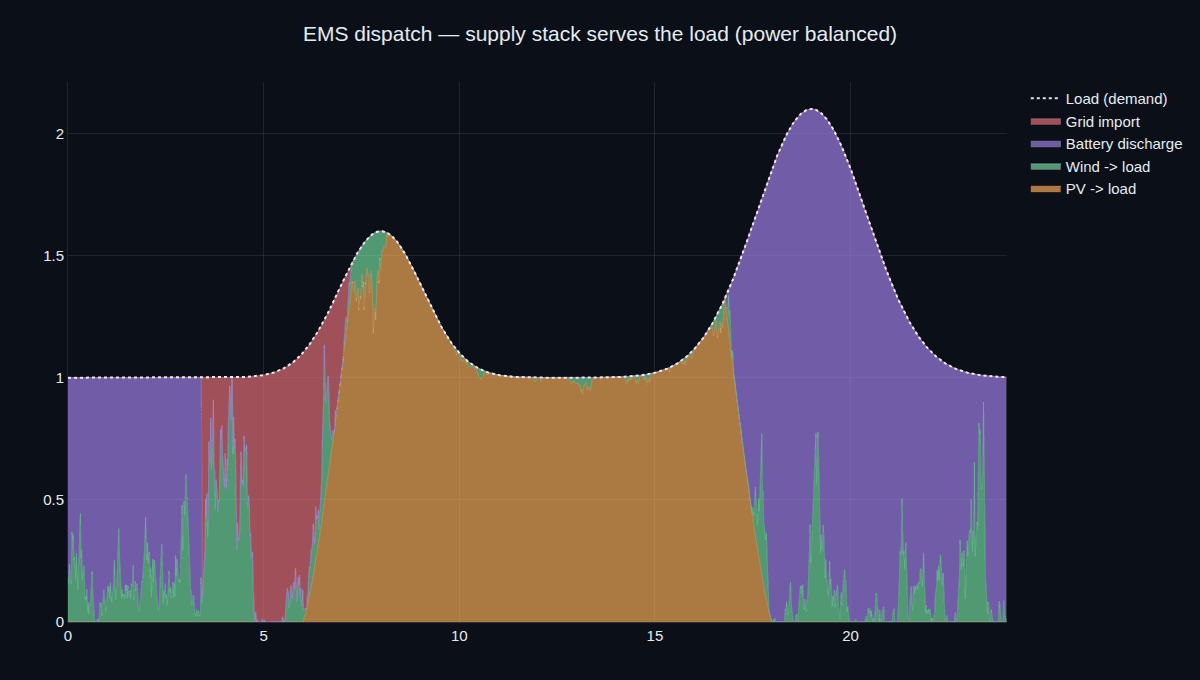 MicrogridsMicrogridSolar PV + wind + battery + grid-tie serving a load as one system under an energy-management controller — composed on a DC bus and run over a day: dispatch, self-sufficiency, peak-shaving, sizing, and islanded stability.
 DjiniousLab
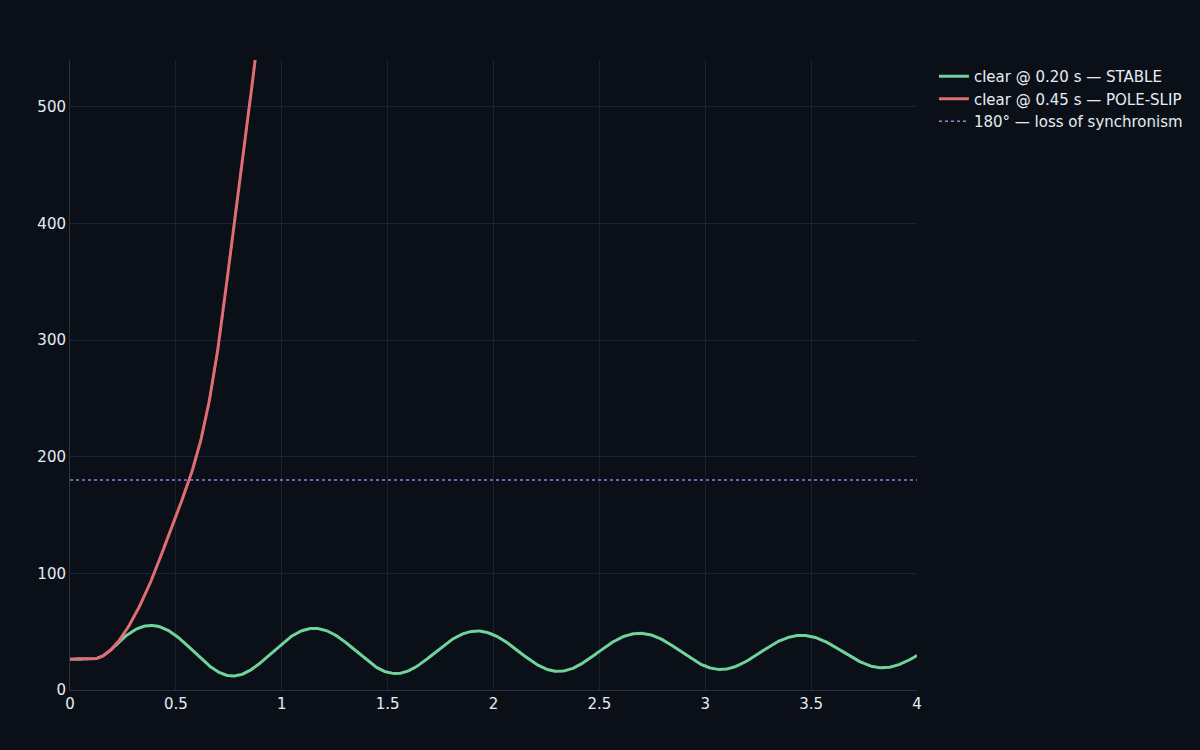 Power gridsAC grid stabilityDoes the grid survive the fault? Synchronous machines whose rotor angles must stay in step, a three-phase short circuit, and the critical clearing time that separates a recoverable swing from a blackout — the swing equation, the equal-area criterion, multi-machine stability, and the low-inertia renewables concern.DjiniousLab